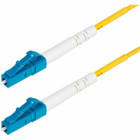




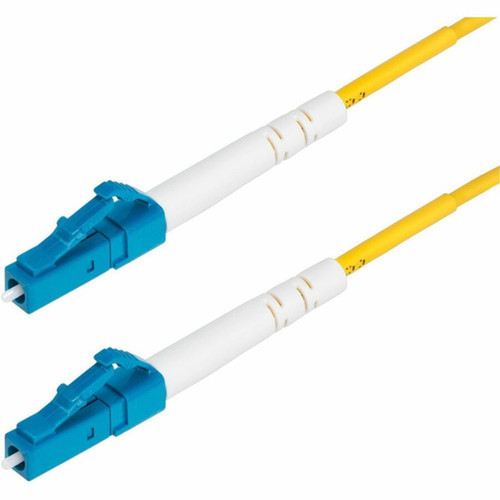
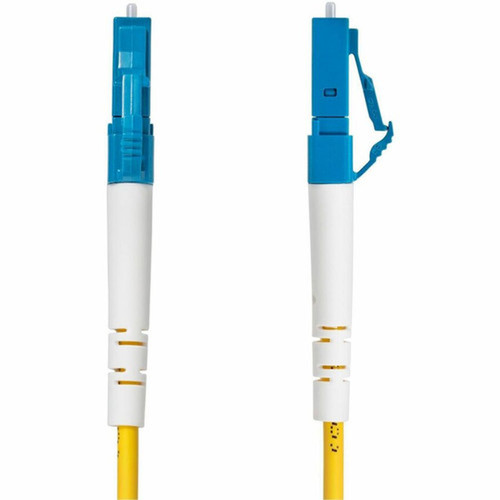
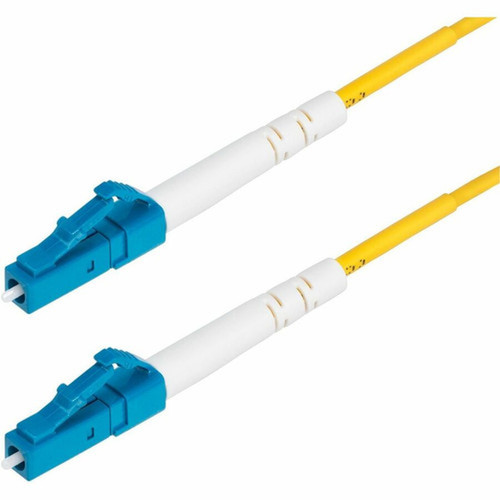
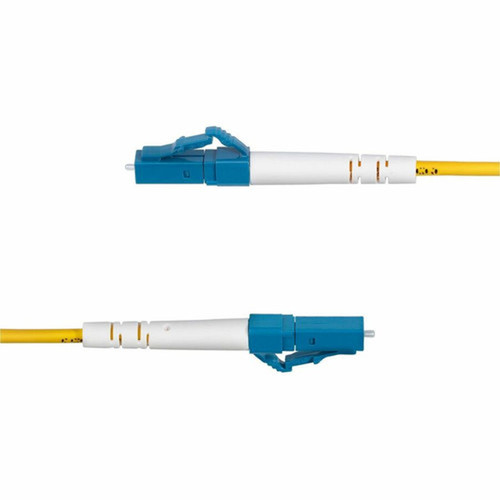
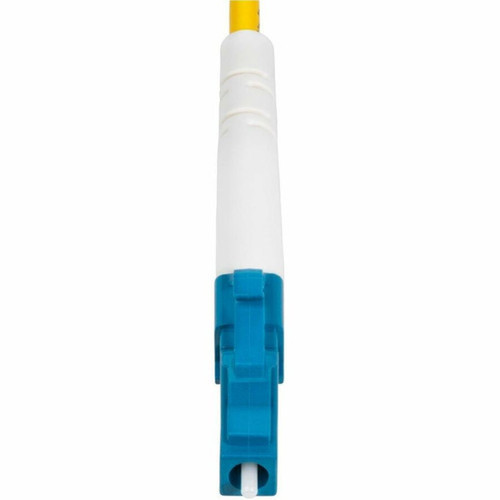

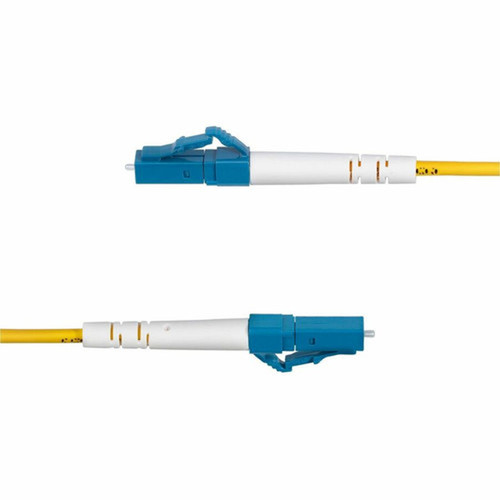
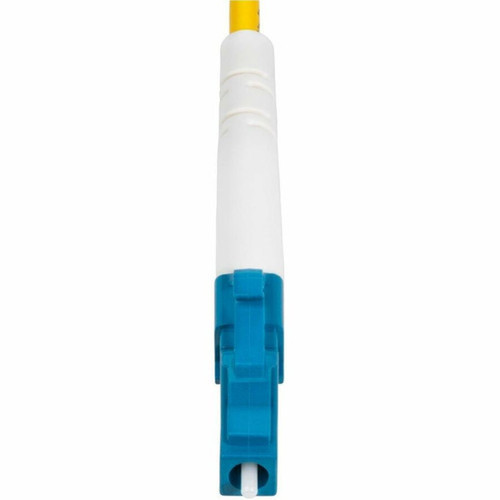
StarTech. com SPSMLCLC-OS2-30M LC to LC - UPC OS2 Single Mode Simplex Fiber Optic Cable - 30m - 98. 4ft - 9/125 - 40G/100G - Low Insertion Loss - LSZH

Business volume discounts
Technical guidance
Preparation & staging
QC · ON · AB · BC
Product Features
Technical Overview
This fiber optic jumper employs single mode technology optimized for laser wavelengths between 1260-1625 nm, ensuring efficient transmission in high-speed networking applications. The Ultra Physical Contact (UPC) polish on LC connectors delivers improved return loss characteristics compared to standard PC polish, reducing signal reflection and maximizing throughput.
With a maximum insertion loss of ≤0.3 dB and return loss of ≥55 dB, the cable exceeds typical industry standards for optical performance. The 2 mm outer diameter cable features aramid reinforcement within its LSZH jacket, providing both mechanical strength and fire safety compliance for enclosed installations.
This section brings together practical product details such as Cable Type, Cable Characteristic, Fiber Optic Mode, Color Family, so buyers can judge configuration, deployment fit, and day-to-day suitability with less guesswork.
Key Product Advantages
This fiber patch cord combines multiple performance and safety features that distinguish it from basic optical cables. The construction addresses both technical requirements and practical installation considerations for modern network infrastructure.
Enhanced Signal Integrity
UPC-polished LC connectors minimize back reflection while the OS2 single mode fiber maintains signal quality over extended distances, supporting both 40G and 100G network standards with reliable performance.
- Ultra Physical Contact polish reduces return loss
- OS2 fiber optimized for 1260-1625 nm wavelengths
- Supports bi-directional (BiDi) transmission
Robust Physical Design
The bend-insensitive fiber core withstands tight installation bends down to 10 mm radius without signal degradation, while the aramid-reinforced LSZH jacket provides mechanical protection and fire safety compliance.
- 10 mm loaded bend radius capability
- Aramid reinforcement for tensile strength
- LSZH jacket emits low toxic fumes if combusted
Deployment / Use Cases
This simplex fiber optic cable serves as an essential component in various high-speed networking scenarios where reliable point-to-point connections are required. Its single-fiber design makes it particularly valuable in installations where fiber count minimization is important.
The cable is compatible with network devices, servers, switches, and storage equipment, providing connectivity between SFP/SFP+ transceivers in data centers, enterprise networks, and telecommunications infrastructure. Its 30-meter length offers flexibility for rack-to-rack or within-cabinet connections in medium-distance applications.
Data Center Interconnects
Connect switches, routers, and servers within data center environments where 40G/100G throughput is required between adjacent racks or within the same cabinet row.
Network Infrastructure Links
Establish reliable connections between network equipment in enterprise environments, supporting high-bandwidth applications and storage area networks with minimal signal loss.
Highlights
- 30-meter (98.4-foot) LC to LC single mode simplex fiber optic patch cable
- OS2-grade fiber supports 40G/100G networks with backward compatibility to OS1
- Ultra Physical Contact (UPC) polish on LC connectors for improved return loss
- Bend-insensitive fiber core with 10 mm loaded bend radius capability
- LSZH (Low Smoke Zero Halogen) jacket for enhanced fire safety in enclosed spaces
- 9/125 µm core/cladding structure optimized for 1260-1625 nm wavelengths
- Maximum insertion loss of ≤0.3 dB and return loss of ≥55 dB
- Aramid-reinforced construction for durability and tensile strength
- Yellow jacket color identifies single mode fiber per industry standards
- Lifetime warranty for long-term reliability assurance
Specifications
| Specifications | |
|---|---|
| Manufacturer | StarTech.com |
| Manufacturer Part Number | SPSMLCLC-OS2-30M |
| Brand Name | StarTech.com |
| Product Name | Fiber Optic Simplex Patch Network Cable |
| Packaged Quantity | 1 |
| Product Type | Network Cable |
| Technical Information | |
| Cable Type | Fiber Optic |
| Cable Characteristic | Patch Cable |
| Fiber Optic Mode | Single-mode |
| Fiber Type | Simplex |
| Fiber Category | OS2 |
| Cable Length | 98.4 ft (30 m) |
| Connector Type on First End | LC Network - Male |
| Connector Gender on First End | Male |
| Connector on First End Details | 1 x LC Network - Male |
| Connector Type on Second End | LC Network - Male |
| Connector Gender on Second End | Male |
| Connector on Second End Details | 1 x LC Network - Male |
| Jacket Type | LSZH |
| Device Supported | Network Device,Server,Switch,Storage Device |
| Data Transfer Rate | 100 Gbit/s |
| Features | Ultra Physical Contact (UPC),Bend Insensitive,Flame Retardant,Bend Resistant,Passive |
| Physical Characteristics | |
| Color Family | Yellow |
| Product Color | Yellow |
| Product Material | Polypropylene |
| Jacket Material | Low Smoke Zero Halogen |
| Miscellaneous | |
| Environmentally Friendly | Yes |
| Environmental Compliance | Waste Electrical and Electronic Equipment Directive (WEEE) |
| Warranty | |
| Limited Warranty | Lifetime |
User Manual
FAQ
What is the difference between simplex and duplex fiber optic cables?
Simplex fiber cables contain a single fiber strand and are used for one-way transmission or bi-directional communication over a single fiber. This StarTech.com cable is a simplex design, making it ideal for applications where space is limited or when using single-fiber transceivers. Duplex cables contain two fibers (typically for transmit and receive) and are more common in standard network installations.
What does OS2 single mode fiber mean for my network?
OS2 is the performance specification for single mode fiber optimized for use with laser sources. This cable meets OS2 standards, which means it supports higher bandwidth over longer distances compared to multimode fiber. It's specifically designed for 40G and 100G network applications and maintains backward compatibility with OS1 installations, providing a future-proof solution for high-speed network upgrades.
Why are UPC connectors preferred over PC connectors?
UPC (Ultra Physical Contact) connectors feature a curved end-face polish that creates better physical contact between fiber ends, resulting in lower back reflection and improved return loss compared to standard PC (Physical Contact) connectors. This StarTech.com cable uses UPC-polished LC connectors, which minimize signal reflection at connection points, ensuring optimal performance in high-speed 40G/100G networks where signal integrity is critical.
What are the benefits of an LSZH jacket for this fiber cable?
The LSZH (Low Smoke Zero Halogen) jacket emits minimal smoke and no halogen gases when exposed to fire, making this cable safer for use in enclosed spaces, poorly ventilated areas, and public buildings. This is particularly important in data centers and network cabinets where multiple cables are bundled together. The LSZH material also meets environmental compliance standards while providing the necessary mechanical protection for the fiber.
How does bend-insensitive fiber improve installation flexibility?
Bend-insensitive fiber incorporates a special design in the core that reduces signal loss when the cable is bent. This StarTech.com cable features bend-insensitive technology that allows it to be routed around tight corners with a loaded bend radius as small as 10 mm (0.39 inches) without significant performance degradation. This makes installation easier in crowded network cabinets and allows for more flexible cable management without compromising signal quality.
What devices and applications is this fiber cable compatible with?
This LC to LC simplex fiber optic cable is compatible with network devices, servers, switches, and storage equipment that use LC fiber interfaces. It works with SFP, SFP+, and other optical transceivers supporting single mode fiber. The cable is ideal for point-to-point connections in data centers, enterprise networks, and telecommunications infrastructure, particularly for 40G/100G applications, storage area networks, and any installation requiring high-bandwidth, low-latency connections over moderate distances.
| Qty | Price | Available |
|---|