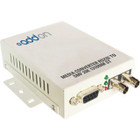








AddOn ADD-RS232-2ST Serial RS232 to Fiber SMF 1310nm 20km ST Media Converter - 1 x ST Port - 115. 20 kbit/s - Desktop

Business volume discounts
Technical guidance
Preparation & staging
QC · ON · AB · BC
Product Features
Technical Overview
This media converter operates with a 1310 nm wavelength on single-mode fiber, providing efficient optical transmission for long-haul links. The device handles a maximum data transfer rate of 115.20 kbit/s, aligning with standard RS232 serial communication speeds for devices like PLCs, terminals, and modems.
The converter includes two ports total, with one dedicated duplex ST port for fiber connections. It does not support RJ-45 Ethernet, DVI, USB, or management ports, focusing purely on serial-to-fiber conversion. Power is supplied via an AC/DC source, ensuring flexible deployment in various electrical environments.
This section brings together practical product details such as Total Number of Ports, Network (RJ-45), DVI, Media Type Supported, so buyers can judge configuration, deployment fit, and day-to-day suitability with less guesswork.
Key Product Advantages
This converter eliminates distance barriers for serial communications by leveraging fiber optic technology, which offers immunity to electromagnetic interference and reduced signal degradation compared to copper cabling. The 20 km reach enables connectivity between dispersed serial devices without intermediate repeaters.
Long-Distance Reliability
Supports transmission up to 20 km on single-mode fiber, ensuring stable serial communication for remote installations.
- Minimal signal loss over distance
- Immune to EMI/RFI interference
Simplified Deployment
Desktop form factor and AC/DC power allow easy placement in control rooms, racks, or workspaces without specialized mounting.
- Standalone installation
- Flexible power input
Deployment / Use Cases
The ADD-RS232-2ST is ideal for extending serial connections in environments where copper cabling is impractical or prone to interference. Its 20 km capability suits applications like connecting serial devices across industrial plants, transportation systems, or utility networks.
Common use cases include integrating legacy RS232 equipment into modern fiber-based networks, enabling remote monitoring of serial sensors or controllers, and bridging serial data between buildings or facilities. The converter supports scenarios such as factory automation, traffic control systems, and environmental monitoring where reliable long-distance serial communication is critical.
Industrial Automation
Connect PLCs, HMIs, or serial sensors over fiber to central control systems in manufacturing or processing plants.
Infrastructure Monitoring
Extend serial links for SCADA, telemetry, or alarm systems in utilities, transportation, or telecommunications networks.
Physical Profile
The converter features a compact desktop form factor measuring 4.50" (114.30 mm) in height, 3.50" (88.90 mm) in width, and 0.75" (19.05 mm) in depth, with an approximate weight of 1.80 lb (816.47 g). Its slim design allows for space-efficient placement on desks, shelves, or in enclosures, and the sturdy construction ensures durability in operational environments.
- Width
- 3.50" (88.90 mm)
- Depth
- 0.75" (19.05 mm)
- Height
- 4.50" (114.30 mm)
- Weight
- 1.80 lb (816.47 g)
- Length
- 1310 nm
Highlights
- Converts RS232 serial to single-mode fiber optic signals
- Supports 20 km distance for long-haul serial communication
- Uses 1310 nm wavelength on single-mode fiber
- Data transfer rate of 115.20 kbit/s
- Features one duplex ST port for fiber connectivity
- Desktop form factor for easy standalone installation
- AC/DC power source for flexible deployment
- 3-year limited warranty for reliability assurance
Specifications
| Specifications | |
|---|---|
| Manufacturer | AddOn |
| Manufacturer Part Number | ADD-RS232-2ST |
| Brand Name | AddOn |
| Product Model | ADD-RS232-2ST |
| Product Name | Media Converter Rs232 To Smf 1310Nm St 20Km Reach |
| Packaged Quantity | 1 |
| Product Type | Transceiver/Media Converter |
| Interfaces/Ports | |
| Total Number of Ports | 2 |
| Network (RJ-45) | No |
| DVI | No |
| USB | No |
| Management Port | No |
| Number of ST Ports | 1 |
| ST Port Type | Duplex |
| Media & Performance | |
| Media Type Supported | Optical Fiber |
| Fiber Mode Supported | Single-mode |
| Fiber Optic Cable Wavelength | 1310 nm |
| Maximum Data Transfer Rate | 115.20 kbit/s |
| Maximum Distance Supported | 20 km (12.43 Mile) |
| Power Description | |
| Power Source | AC/DC |
| Physical Characteristics | |
| Form Factor | Desktop |
| Height | 4.50" (114.30 mm) |
| Width | 3.50" (88.90 mm) |
| Depth | 0.75" (19.05 mm) |
| Weight (Approximate) | 1.80 lb (816.47 g) |
| Miscellaneous | |
| Country of Origin | China |
| TAA Compliant | No |
| Warranty | |
| Limited Warranty | 3 Year |
FAQ
What type of conversion does this media converter perform?
This converter transforms RS232 serial electrical signals into optical signals for transmission over single-mode fiber optic cable. It enables serial devices to communicate across distances up to 20 km using fiber, which reduces signal loss and interference compared to traditional copper serial cables.
What is the maximum distance supported by this converter?
The converter supports a maximum distance of 20 kilometers (12.43 miles) over single-mode fiber. This extended reach is ideal for connecting serial equipment in large facilities, between buildings, or across remote sites without requiring signal repeaters or boosters.
What fiber connector type does this converter use?
It uses one duplex ST port for fiber connections. The ST connector is a common type for fiber optic cabling, providing a secure bayonet-style connection suitable for industrial and commercial environments where reliable optical links are needed.
What is the data transfer rate of this serial-to-fiber converter?
The converter supports a maximum data transfer rate of 115.20 kbit/s, which aligns with standard RS232 serial communication speeds. This rate is sufficient for most serial devices like terminals, modems, and industrial controllers, ensuring compatible performance without bottlenecks.
How is this converter powered?
It uses an AC/DC power source, allowing flexibility in deployment with various power supplies. This design supports installation in different electrical environments, from office settings to industrial sites, without requiring specialized power infrastructure.
What is the form factor and installation method for this converter?
The converter has a desktop form factor, meaning it is designed to sit on a flat surface like a desk, shelf, or rack shelf. Its compact dimensions (4.50" H x 3.50" W x 0.75" D) and standalone design enable easy placement without mounting hardware, simplifying setup in control rooms or equipment cabinets.
| Qty | Price | Available |
|---|