








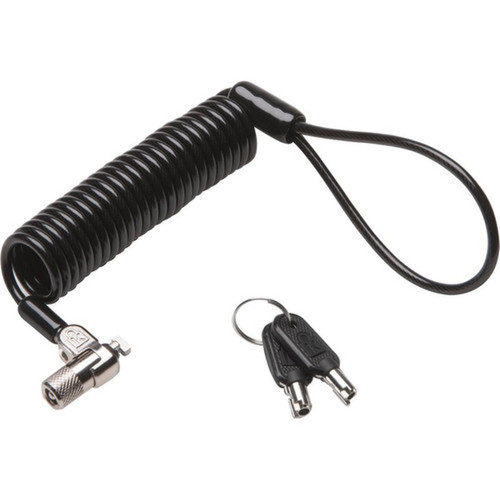

Kensington K64423WW MicroSaver 2. 0 Portable Keyed Laptop Lock - 6 ft (1. 83 m) Carbon Steel Cable - For Notebook Security

Business volume discounts
Technical guidance
Preparation & staging
QC · ON · AB · BC
Product Features
Technical Overview
Engineered with a 10mm lock head that fits even the thinnest modern laptops, the MicroSaver 2.0 employs Kensington's T-Bar Locking Technology for a secure connection to the Kensington Security Slot. The patented Hidden Pin Technology adds an anti-pick layer that distinguishes Kensington locks from generic cable locks, providing enhanced resistance to tampering.
The carbon steel cable maintains strength while offering flexibility, with a pivot-and-rotate ball joint that ensures optimal engagement with the device slot regardless of orientation. Independent testing verifies performance against industry standards for torque, pull resistance, lock lifecycle, corrosion, key strength, and environmental durability.
Relevant factors for this section include Lock Configuration Type, Cable Length, Product Material. When those points are considered together, they give buyers a clearer picture of how the product is equipped, how it fits into deployment, and what kind of day-to-day role it is meant to support.
Key Product Advantages
The MicroSaver 2.0 offers several distinct advantages for securing valuable portable equipment. Its combination of physical durability and intelligent locking design addresses common security vulnerabilities in shared or high-traffic settings.
Universal Compatibility
Works with any device featuring the Kensington Security Slot, which is standard on most laptops, tablets, monitors, and projectors from major manufacturers.
- Fits ultra-thin devices
- No tools required for installation
Portable Security
The self-coiling cable design allows the lock to be easily carried and deployed wherever needed, providing security on the go without bulk or weight penalties.
- Compact storage
- Lightweight construction
Verified Durability
Independently tested to withstand forceful attacks, environmental exposure, and repeated use cycles, ensuring long-term reliability for institutional deployments.
- Anti-corrosion treatment
- High-cycle key mechanism
Deployment / Use Cases
This keyed laptop lock serves organizations that need to secure devices while maintaining accessibility for authorized users. The physical tether prevents casual theft in environments where equipment cannot be locked away entirely.
Common deployment scenarios include open-plan offices where laptops remain on desks overnight, classroom settings where devices are shared between sessions, retail displays where demonstration units must stay in place, and healthcare facilities where mobile workstations transport sensitive information. The lock also provides basic security for temporary workstations at conferences, trade shows, and co-working spaces.
Relevant factors for this section include Lock Configuration Type, Cable Length, Product Material. When those points are considered together, they give buyers a clearer picture of how the product is equipped, how it fits into deployment, and what kind of day-to-day role it is meant to support.
Highlights
- 10mm lock head provides secure fit for thin laptops and portable devices
- Patented Hidden Pin Technology offers anti-pick protection unique to Kensington
- T-Bar Locking Technology attaches securely to standard Kensington Security Slots
- Self-coiling carbon steel cable extends to 6 ft, retracts to 3 in for portability
- Pivot-and-rotate ball joint ensures optimal engagement with device security slot
- Independently tested for torque, pull resistance, corrosion, and lifecycle durability
- TAA compliant for government and institutional procurement requirements
- Keyed operation simplifies management in multi-user environments
Specifications
| Specifications | |
|---|---|
| Manufacturer | Kensington Computer Products Group |
| Manufacturer Part Number | K64423WW |
| Brand Name | Kensington |
| Product Line | MicroSaver 2.0 |
| Product Name | MicroSaver 2.0 Portable Keyed Laptop Lock |
| Product Type | Cable Lock |
| Lock | |
| Lock Configuration Type | Keyed Lock |
| Cable Length | 6 ft (1.83 m) |
| Physical Characteristics | |
| Product Material | Carbon Steel |
| Miscellaneous | |
| Device Supported | Notebook |
| Country of Origin | China |
FAQ
What devices are compatible with the Kensington MicroSaver 2.0 lock?
The MicroSaver 2.0 is designed for any device equipped with a Kensington Security Slot, which is a standard security feature on most laptops, tablets, monitors, projectors, and other portable electronics from major manufacturers. The 10mm lock head accommodates even the thinnest modern ultrabooks and devices with minimal clearance around their security slots.
How does the self-coiling cable work and what are its dimensions?
The carbon steel cable can extend to its full 6-foot (1.83-meter) length when you need to secure a device to a fixed anchor point, then retract down to approximately 3 inches for compact storage. This self-coiling design eliminates cable tangles and makes the lock highly portable without requiring separate cable management.
What security features distinguish Kensington's Hidden Pin Technology?
Hidden Pin Technology is a patented Kensington innovation that incorporates anti-pick mechanisms within the lock cylinder. This makes the MicroSaver 2.0 more resistant to picking attempts compared to basic cable locks, providing an additional layer of security against skilled tampering in environments where devices might be unattended for extended periods.
Is this lock suitable for government or educational procurement?
Yes, the MicroSaver 2.0 is TAA (Trade Agreements Act) compliant, which means it meets the requirements for U.S. federal government purchasing and many state, local, and educational institution procurement programs. This compliance ensures the lock can be used in contracts that require TAA-certified products.
How durable is the carbon steel construction?
The carbon steel cable and lock components have undergone independent testing against industry standards for durability. Tests include torque resistance, pull strength, lock lifecycle (number of locking/unlocking cycles), corrosion resistance, key strength, and environmental conditions. This verified durability makes the lock suitable for long-term deployment in institutional settings.
What are the advantages of a keyed lock versus a combination lock?
Keyed operation simplifies management in organizational environments where multiple users need access. Administrators can maintain control through key distribution rather than sharing combination codes, which can be more easily disseminated or forgotten. Keyed locks also typically offer more robust mechanical construction than combination mechanisms at this price point.
| Qty | Price | Available |
|---|