






Shipping included*
Exclusions
Additional shipping fees may apply in rare circumstances for deliveries outside standard service areas. In most cases, this only potentially affects shipments to the Northwest Territories and Yukon, as well as certain heavy or oversized items.
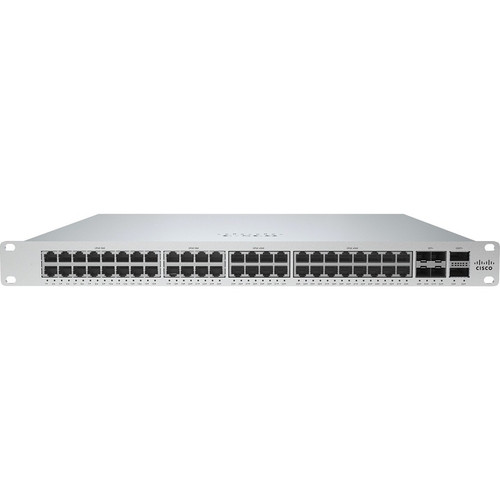
Meraki MS355-48X2-HW Layer 3 Switch - 48 Ports - 24 x 10G - 24 x 1G - Modular - 2 x 40G Uplinks - 1U Rack-Mountable

Business volume discounts
Technical guidance
Preparation & staging
QC · ON · AB · BC
Product Features
Technical Overview
The MS355-48X2-HW operates at Layer 3, supporting advanced routing protocols, VLANs, and access control lists for segmented and secure network traffic. Its port configuration includes 24 Gigabit Ethernet ports for standard client and device connectivity, plus 24 10 Gigabit Ethernet ports for high-bandwidth servers, storage, and uplink aggregation.
Two 40 Gigabit Ethernet uplink ports provide high-speed backbone connections, while eight expansion slots accommodate QSFP28, SFP+, or QSFP+ modules for fiber or copper media. The switch supports twisted pair and optical fiber cables, with network technologies spanning 10GBase-T, 1000Base-T, 10GBase-X, 40GBase-X, and 100GBase-X for compatibility across diverse infrastructure.
Relevant factors for this section include Total Number of Network Ports, Uplink Port, Modular, Media Type Supported. When those points are considered together, they give buyers a clearer picture of how the product is equipped, how it fits into deployment, and what kind of day-to-day role it is meant to support.
Key Product Advantages
The Meraki MS355-48X2-HW excels in environments where port density, uplink capacity, and cloud-based management are critical. Its hybrid port layout allows seamless integration of legacy Gigabit devices with modern 10G equipment, reducing the need for intermediate upgrades.
High-Density Connectivity
With 48 ports split between Gigabit and 10 Gigabit speeds, this switch supports a wide range of devices from desktop PCs to high-performance servers, optimizing network throughput without oversubscription.
Scalable Uplinks
The dual 40G uplinks and 100G stacking ports enable robust backbone connections and easy network expansion, ensuring bandwidth headroom for growing traffic demands.
Cloud Management
Meraki's dashboard provides real-time monitoring, automated firmware updates, and intuitive configuration tools, reducing operational overhead and enhancing network reliability.
Deployment / Use Cases
The MS355-48X2-HW is ideal for core switching in medium to large enterprises, where its port count and Layer 3 capabilities support complex routing and segmentation. It serves as an aggregation switch in campus networks, connecting multiple access switches and providing high-speed uplinks to the core.
In data center environments, this switch handles server-to-server traffic, storage networking, and virtualized infrastructure, thanks to its 10G ports and low-latency performance. Its modular expansion slots allow customization for fiber-based long-distance links or high-density copper deployments.
Enterprise Core Switching
Deploy as a core switch to route traffic between VLANs, enforce security policies, and aggregate uplinks from access layers, leveraging Layer 3 features for optimized network performance.
Data Center Aggregation
Use in data center top-of-rack or end-of-row configurations to connect servers, storage arrays, and hypervisors, with 10G ports ensuring low-latency, high-throughput data transfers.
Physical Profile
The switch measures 1.72 inches in height, 19.08 inches in width, and 20.34 inches in depth, fitting standard 1U rack spaces with a weight of approximately 13.14 pounds. Its rack-mountable design includes front-accessible ports and rear power inputs, facilitating tidy cable management in rack enclosures. The compact footprint makes it suitable for space-constrained installations without sacrificing port density or cooling efficiency.
- Width
- 19.08" (484.63 mm)
- Depth
- 20.34" (516.64 mm)
- Height
- 1.72" (43.69 mm)
- Weight
- 13.14 lb (5960.20 g)
Highlights
- 48 total network ports with 24 Gigabit and 24 10 Gigabit Ethernet for mixed-speed deployments.
- Layer 3 switching supports advanced routing, VLANs, and access control for secure segmentation.
- Two 40 Gigabit Ethernet uplink ports provide high-speed backbone connectivity.
- Modular design with 8 expansion slots for QSFP28, SFP+, or QSFP+ media modules.
- Stackable via 100 Gigabit Ethernet ports for easy network expansion and management.
- Cloud-managed through Meraki dashboard for centralized visibility and automation.
- 1U rack-mountable form factor fits standard data center and closet installations.
- Supports both twisted pair and optical fiber cables for flexible media options.
- 740W power consumption with redundant power supply support for high availability.
- Manufactured by Cisco Systems, Inc., with origin in Taiwan.
Specifications
| Specifications | |
|---|---|
| Manufacturer | Cisco Systems, Inc |
| Manufacturer Part Number | MS355-48X2-HW |
| Brand Name | Meraki |
| Product Series | MS355 |
| Product Model | MS355-48X2 |
| Product Name | MS355-48X2 Layer 3 Switch |
| Product Type | Layer 3 Switch |
| Interfaces/Ports | |
| Total Number of Network Ports | 48 |
| Uplink Port | Yes |
| Modular | Yes |
| Stack Port | Yes |
| Port/Expansion Slot Details | 24 x 10 Gigabit Ethernet Network,24 x Gigabit Ethernet Network,2 x 40 Gigabit Ethernet Uplink,4 x 10 Gigabit Ethernet Expansion Slot,2 x 100 Gigabit Ethernet Stack |
| Media & Performance | |
| Media Type Supported | Twisted Pair,Optical Fiber |
| Ethernet Technology | 10 Gigabit Ethernet,Gigabit Ethernet,40 Gigabit Ethernet,100 Gigabit Ethernet |
| Network Technology | 10GBase-T,1000Base-T,10GBase-X,40GBase-X,100GBase-X |
| I/O Expansions | |
| Total Number of Expansion Slots | 8.0 |
| Expansion Slot Type | QSFP28,SFP+,QSFP+ |
| Number of SFP+ Slots | 4 |
| Network & Communication | |
| Layer Supported | 3 |
| Management & Protocols | |
| Manageable | Yes |
| Power Description | |
| Power Source | Power Supply |
| Redundant Power Supply Supported | Yes |
| Power Consumption | 740 W |
| Physical Characteristics | |
| Compatible Rack Unit | 1U |
| Form Factor | Rack-mountable |
| Height | 1.72" (43.69 mm) |
| Width | 19.08" (484.63 mm) |
| Depth | 20.34" (516.64 mm) |
| Weight (Approximate) | 13.14 lb (5960.20 g) |
| Miscellaneous | |
| Country of Origin | Taiwan |
FAQ
What is the total number of ports on the Meraki MS355-48X2-HW switch?
The Meraki MS355-48X2-HW switch has 48 total network ports. This includes 24 Gigabit Ethernet ports for standard connectivity and 24 10 Gigabit Ethernet ports for high-bandwidth applications, providing a balanced mix for diverse network devices and servers.
Does this switch support Layer 3 functionality?
Yes, the MS355-48X2-HW is a Layer 3 managed switch. It supports advanced routing protocols, VLAN routing, and access control lists, enabling efficient traffic segmentation, inter-VLAN communication, and enhanced network security in enterprise environments.
What types of uplink ports are available on this switch?
This switch includes two 40 Gigabit Ethernet uplink ports for high-speed backbone connections. Additionally, it has two 100 Gigabit Ethernet stack ports for linking multiple switches together, facilitating scalable network expansion and simplified management.
Is the Meraki MS355-48X2-HW switch modular?
Yes, the switch features a modular design with 8.0 total expansion slots. These slots support QSFP28, SFP+, and QSFP+ modules, allowing customization for fiber or copper media, including 4 dedicated SFP+ slots for 10 Gigabit Ethernet expansion.
What is the power consumption and rack unit size of this switch?
The switch consumes 740 watts of power and supports redundant power supplies for high availability. It has a 1U rack-mountable form factor, with dimensions of 1.72" height, 19.08" width, and 20.34" depth, making it compatible with standard rack installations.
How is the Meraki MS355-48X2-HW managed?
This switch is cloud-managed through the Meraki dashboard, which provides centralized configuration, real-time monitoring, automated updates, and troubleshooting tools. This cloud-based approach reduces on-site management overhead and enhances network visibility across distributed deployments.
| Qty | Price | Available |
|---|