






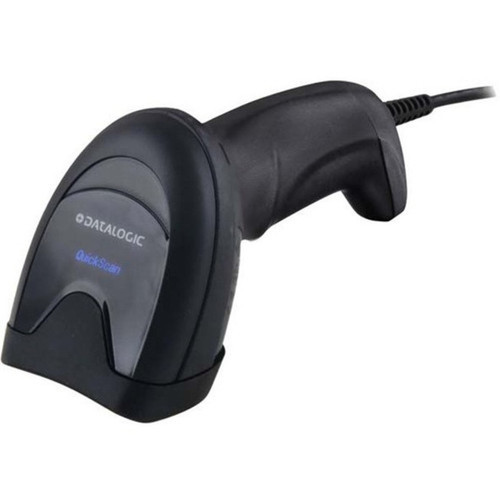
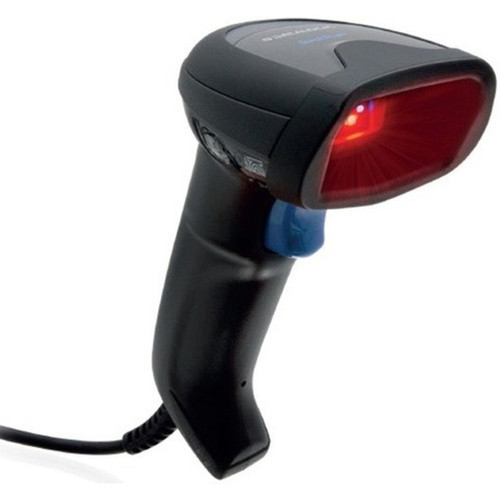

Datalogic QD2590-BKK1S QuickScan 2500 Barcode Scanner Kit - 1D/2D Omni-directional Imager - 20. 10" Scan Distance - USB - Serial - Keyboard Wedge

Business volume discounts
Technical guidance
Preparation & staging
QC · ON · AB · BC
Product Features
Technical Overview
The QuickScan 2500 utilizes advanced image sensor technology to achieve omni-directional scanning, eliminating the need for precise alignment. It reads codes at distances up to 20.10 inches with a motion tolerance of 30 inches per second, ensuring reliable first-pass reads even on fast-moving items. The scanner supports image capture in JPEG, BMP, and TIFF formats for documentation and verification purposes.
Reading angles are optimized for real-world use, with 65° skew and pitch tolerance and a full 360° roll capability. This allows the scanner to decode barcodes presented at various orientations without repositioning. The unit maintains performance on low-contrast prints as low as 15% and resolves Code 39 elements from 5 mil to 10 mil, with specific resolutions for DataMatrix and PDF417 codes.
This section brings together practical product details such as Connectivity Technology, Scanning Capability, Barcode Symbology Supported, Host Interface, so buyers can judge configuration, deployment fit, and day-to-day suitability with less guesswork.
Key Product Advantages
This scanner combines industrial-grade ruggedness with versatile connectivity to serve as a dependable asset across multiple sectors. Its ability to auto-discriminate between a comprehensive range of 1D and 2D symbologies reduces training time and increases operational efficiency.
Superior Durability
Built to survive harsh environments, the scanner meets IP52 ingress protection standards and is tested to withstand repeated 1.5-meter drops onto concrete, minimizing downtime and replacement costs.
- IP52 rated
- 1.5m drop tested
- High ambient light tolerance
Flexible Connectivity
Offers multiple interface options including USB, serial, and keyboard wedge, ensuring compatibility with legacy and modern POS systems, PCs, and terminals without requiring additional adapters.
- USB, Serial, Keyboard Wedge
- Plug-and-play setup
- Broad system compatibility
Wide Application Support
Decodes specialized codes including postal, stacked, and composite barcodes, plus Digimarc digital watermarks (on specific models), making it ideal for retail, logistics, government, and healthcare applications.
- Postal and stacked codes
- Digimarc support
- Multi-sector ready
Deployment / Use Cases
The QuickScan 2500 is engineered for environments where scanning reliability directly impacts productivity and customer service. Its handheld form factor and included stand allow for both mobile and fixed-station use, adapting to various workflow requirements.
In retail and hospitality settings, the scanner accelerates checkout and inventory processes, handling everything from standard UPC codes to 2D coupons and loyalty cards. For government, healthcare, and light manufacturing, its ability to read high-density 2D codes on identification badges, medical devices, and component labels ensures accurate data capture and traceability.
This section brings together practical product details such as Connectivity Technology, Scanning Capability, Barcode Symbology Supported, Host Interface, so buyers can judge configuration, deployment fit, and day-to-day suitability with less guesswork.
Physical Profile
Designed for all-day comfort, the handheld scanner features a lightweight black housing weighing just 5.11 ounces. The compact form factor fits naturally in the hand, reducing user fatigue during extended scanning sessions. The IP52 rating provides protection against limited dust ingress and water dripping, making it suitable for use in retail counters, warehouse floors, and other active workspaces.
The physical profile is practical for deployment planning because the dimensions and weight are clearly defined: 5.11 oz (145 g). This helps confirm rack, shelf, desk, or cabinet fit before installation.
- Weight
- 5.11 oz (145 g)
What's in the Box
The kit includes the QuickScan 2500 handheld barcode scanner and a USB cable for immediate connectivity and power.
Package contents include USB. These included items support setup, installation, and immediate deployment without needing to source the core bundled accessories separately.
Highlights
- Omni-directional 1D/2D imager scanner for flexible code presentation
- 20.10-inch (510.54 mm) scanning distance for extended reach
- USB, serial, and keyboard wedge host interfaces for broad compatibility
- Rugged construction withstands 1.5-meter drops onto concrete (IP52 rated)
- Handheld form factor with included stand for versatile mounting
- Reads a wide range of symbologies including QR, Data Matrix, PDF417, and postal codes
- High ambient light tolerance up to 110,000 lux for outdoor or bright indoor use
- Supports image capture in JPEG, BMP, and TIFF formats
- Environmentally compliant with RoHS and China RoHS standards
- Ideal for retail, hospitality, healthcare, government, and light industrial applications
Specifications
| Specifications | |
|---|---|
| Manufacturer | Datalogic S.p.A |
| Manufacturer Part Number | QD2590-BKK1S |
| Brand Name | Datalogic |
| Product Line | QuickScan |
| Product Series | 2500 |
| Product Model | QD2500 |
| Product Name | QuickScan 2500 |
| Product Type | Barcode Scanner Kit |
| Technical Information | |
| Connectivity Technology | Cable |
| Scanning Capability | 1D,2D |
| Barcode Symbology Supported | 1D : Auto discriminates all standard 1D codes including GS1 DataBar™ linear codes. 2D : Aztec Code China Han Xin Code Data Matrix MaxiCode Micro QR Code QR Code Dot code Postal Codes : Australian Post British Post China Post IMB Japanese Post KIX Post Planet Code Postnet Royal Mail Code (RM4SCC) Stacked Codes : EAN/JAN Composites GS1 DataBar Composites GS1 DataBar Expanded Stacked GS1 DataBar Stacked GS1 DataBar Stacked Omnidirectional MacroPDF MicroPDF417 PDF417 UPC A/E Composites Digital Watermarking : Digimarc Barcodes (QD2500, QM2500, QBT2500 only) |
| Image Sensor Type | Imager |
| Scan Pattern | Omni-directional |
| Scanning Distance | 20.10" (510.54 mm) |
| Cable Type Included | USB |
| Stand Included | Yes |
| Reading Angle (Skew) | 65° |
| Reading Angle (Pitch) | 65° |
| Reading Angle (Roll) | 360° |
| Motion Tolerance | 30 in/s (762 mm/s) |
| Image Formats | JPEG,BMP,TIFF |
| Maximum Ambient Light | 110000 lux |
| Drop Specification | Withstands repeated drops from 1.5 m / 5.0 ft onto a concrete surface. |
| Minimum Print Contrast | 15% |
| Minimum Element Resolution (Code 39) | 5 mil (0.13 mm) |
| Maximum Element Resolution (Code 39) | 10 mil (0.25 mm) |
| Maximum Element Resolution (DataMatrix) | 10 mil (0.25 mm) |
| Maximum Element Resolution (PDF417) | 6.70 mil (0.17 mm) |
| Interfaces/Ports | |
| Host Interface | USB,Serial,Keyboard Wedge |
| Physical Characteristics | |
| Form Factor | Handheld |
| Color Family | Black |
| Product Color | Black |
| Weight (Approximate) | 5.11 oz (145 g) |
| Miscellaneous | |
| Ingress Protection (IP) Rating | IP52 |
| Application/Usage | Retail,Commercial Service,Hospitality,Ticketing,Government,Healthcare,Light/Clean Manufacturing,Industrial |
| Environmentally Friendly | Yes |
| Environmental Compliance | China Restriction of Hazardous Substances (China RoHS),Restriction of Hazardous Substances (RoHS) |
User Manual
FAQ
What types of barcodes can the Datalogic QuickScan 2500 scan?
The scanner supports both 1D and 2D barcodes. It auto-discriminates all standard 1D linear codes, including GS1 DataBar. For 2D, it reads Aztec Code, Data Matrix, MaxiCode, Micro QR Code, QR Code, and Dot code. It also handles postal codes (like Australian Post, Postnet), stacked codes (PDF417, MacroPDF), and on specific QD2500 series models, Digimarc digital watermarks.
What is the maximum scanning distance for this barcode scanner?
The QuickScan 2500 has a scanning distance of 20.10 inches (510.54 millimeters). This extended range allows operators to scan items without needing to bring the scanner into direct contact, improving workflow speed and ergonomics in retail, warehouse, or industrial settings.
How does the omni-directional scanning feature work?
Omni-directional scanning means the scanner can read barcodes presented at almost any angle without requiring precise alignment. It uses a sophisticated imager and pattern recognition to decode codes regardless of orientation. This is supported by wide reading angles: 65° skew, 65° pitch, and a full 360° roll, significantly reducing scan time and user effort.
What connectivity options are available with this scanner?
The scanner offers multiple host interface options: USB, serial (RS-232), and keyboard wedge. This versatility ensures compatibility with a wide range of systems, from modern PCs and POS terminals to legacy equipment. The kit includes a USB cable, and the keyboard wedge mode allows it to emulate keyboard input for easy integration.
Is the Datalogic QuickScan 2500 durable enough for industrial use?
Yes, it is built for rugged environments. It has an IP52 ingress protection rating, protecting against limited dust and dripping water. It is also drop-tested to withstand repeated falls from 1.5 meters (5 feet) onto concrete. This durability makes it suitable for retail, light manufacturing, warehouse, and other demanding applications.
What is included in the box with the QuickScan 2500 scanner kit?
The kit includes the Datalogic QuickScan 2500 handheld barcode scanner and a USB cable. A stand is also included, providing the option for hands-free, presentation-style scanning at fixed workstations like retail checkouts or service counters.
What duplex or duty-cycle detail is listed?
the specifications are intended to help buyers confirm fit, compatibility, and expected day-to-day operation. In practical terms, the best reading of this product comes from how its hardware, connectivity, and deployment details work together.
What connectivity options are listed?
Connectivity details help confirm how the product integrates with your network, accessories, and surrounding peripherals before rollout or replacement planning. They are often the difference between a technically compatible device and one that is genuinely easy to deploy.
| Qty | Price | Available |
|---|