








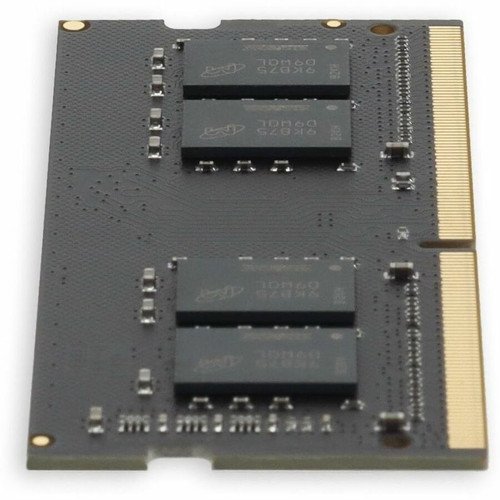
AddOn T7B76UT-AA 4GB DDR4-2133MHz SODIMM - Notebook Memory - 260-pin Unbuffered Single Rank CL15 1.2V

Business volume discounts
Technical guidance
Preparation & staging
QC · ON · AB · BC
Product Features
Product Overview
The AddOn T7B76UT-AA is a 4GB DDR4 SODIMM memory module engineered for notebook systems. This module delivers 2133MHz speed with CL15 latency, providing responsive performance for everyday computing tasks. Built with 260-pin SODIMM form factor, it fits standard notebook memory slots and operates at a low 1.2V for efficient power consumption.
Designed as a single 4GB module, this memory offers straightforward capacity expansion for systems requiring additional RAM. The unbuffered, non-ECC design ensures broad compatibility with consumer and business notebooks that don't require error-correcting memory. With DDR4 SDRAM technology, this module supports modern memory architectures for improved data transfer efficiency.
Relevant factors for this section include Memory Size, Memory Technology, Memory Voltage, Number of Pins. When those points are considered together, they give buyers a clearer picture of how the product is equipped, how it fits into deployment, and what kind of day-to-day role it is meant to support.
Technical Overview
This memory module implements DDR4-2133/PC4-17066 standards, delivering data transfer rates that enhance system responsiveness. The 2133MHz operating frequency combined with CL15 latency timing provides balanced performance for multitasking and application loading. Single-rank architecture optimizes signal integrity while maintaining compatibility with systems designed for this configuration.
The 260-pin SODIMM interface ensures proper physical and electrical connection with notebook memory slots. Operating voltage of 1.2V reduces power consumption compared to previous DDR generations, contributing to longer battery life in portable systems. Unbuffered signal processing provides direct memory access without additional latency from buffering circuits.
Relevant factors for this section include Memory Size, Memory Technology, Memory Voltage, Number of Pins. When those points are considered together, they give buyers a clearer picture of how the product is equipped, how it fits into deployment, and what kind of day-to-day role it is meant to support.
Key Product Advantages
This AddOn memory module provides reliable notebook memory expansion with specifications optimized for modern computing needs. The combination of DDR4 technology and 2133MHz speed delivers noticeable performance improvements over older memory standards.
Notebook-Optimized Design
The 260-pin SODIMM form factor is specifically engineered for notebook systems, ensuring proper fit and reliable operation in portable computing environments.
- Standard notebook memory slot compatibility
- Compact form factor for space-constrained systems
- Low-profile design for thermal management
Efficient Performance Profile
With 2133MHz speed and CL15 latency, this memory provides responsive performance for everyday computing while operating at efficient 1.2V power levels.
- Balanced speed and latency for general computing
- Lower voltage reduces power consumption
- Supports modern processor memory controllers
Deployment / Use Cases
This 4GB DDR4 SODIMM is ideal for notebook memory upgrades where additional RAM capacity improves system performance. It serves as a practical solution for systems experiencing slowdowns during multitasking or when running memory-intensive applications.
Common deployment scenarios include business notebooks requiring memory expansion for productivity software, educational laptops needing additional capacity for learning applications, and personal systems where upgraded memory extends usable lifespan. The module works well as a standalone upgrade or as part of a memory configuration matching the system's requirements.
Notebook Performance Enhancement
Upgrade older notebooks to DDR4 standards or expand memory in newer systems to improve application responsiveness and multitasking capability.
System Compatibility Upgrades
Replace failed memory modules or expand capacity in systems compatible with 4GB DDR4-2133 SODIMM configurations for restored or enhanced functionality.
Highlights
- 4GB DDR4 SDRAM memory capacity for notebook systems
- 2133MHz operating speed with CL15 latency timing
- 260-pin SODIMM form factor for standard notebook compatibility
- Single-rank, unbuffered architecture for broad system support
- 1.2V operating voltage for efficient power consumption
- Non-ECC design suitable for consumer and business notebooks
- DDR4-2133/PC4-17066 memory standard compliance
- Manufacturer part number T7B76UT-AA for precise identification
Specifications
| Specifications | |
|---|---|
| Manufacturer | AddOn |
| Manufacturer Part Number | T7B76UT-AA |
| Brand Name | AddOn |
| Product Name | 4GB DDR4 SDRAM Memory Module |
| Packaged Quantity | 1 |
| Product Type | RAM Module |
| Technical Information | |
| Memory Size | 4 GB |
| Memory Technology | DDR4 SDRAM |
| Memory Voltage | 1.20 V |
| Number of Modules | 1 x 4GB |
| Memory Speed | 2133 MHz |
| Memory Standard | DDR4-2133/PC4-17066 |
| Memory Rank | Single-rank |
| Error Checking | Non-ECC |
| Signal Processing | Unbuffered |
| CAS Latency | CL15 |
| Device Supported | Notebook |
| Physical Characteristics | |
| Number of Pins | 260-pin |
| Form Factor | SODIMM |
| Miscellaneous | |
| TAA Compliant | No |
| Warranty | |
| Limited Warranty | Lifetime |
FAQ
What type of systems is this memory module compatible with?
This AddOn memory module is designed for notebook systems that support DDR4 SODIMM memory. It specifically fits systems with 260-pin SODIMM slots and is compatible with configurations requiring 4GB DDR4-2133 memory. The unbuffered, non-ECC design makes it suitable for most consumer and business notebooks that don't require error-correcting memory functionality.
What is the difference between single-rank and dual-rank memory?
Single-rank memory modules have memory chips accessible through a single set of memory addresses, while dual-rank modules have two independent sets of chips that share the same connection. This AddOn module uses single-rank architecture, which typically offers slightly better performance in systems optimized for this configuration and maintains compatibility with notebooks designed for single-rank memory modules.
How does DDR4 memory compare to previous DDR generations?
DDR4 memory operates at lower voltage (1.2V compared to DDR3's 1.5V) for improved power efficiency, supports higher data transfer rates, and features increased density per module. This AddOn DDR4-2133 module provides these advantages while maintaining compatibility with systems designed for DDR4 technology, offering better performance and efficiency than older DDR3 equivalents in compatible notebooks.
What does unbuffered memory mean?
Unbuffered memory, also known as unregistered memory, provides direct electrical connection between the memory controller and memory chips without intermediate buffering circuits. This design reduces latency compared to registered/buffered memory but doesn't support error correction. The AddOn T7B76UT-AA uses unbuffered architecture, making it suitable for notebooks that don't require the signal integrity benefits of registered memory.
Can I mix this module with existing memory in my notebook?
Mixing memory modules requires careful consideration of compatibility factors including speed, timing, voltage, and rank configuration. For optimal performance, it's recommended to use identical modules with matching specifications. If mixing is necessary, ensure the notebook's memory controller supports the combined configuration and that all modules operate at the same voltage and compatible timings.
What performance improvement can I expect from upgrading to this memory?
Upgrading to this 4GB DDR4-2133 module from older or lower-capacity memory typically improves system responsiveness, reduces application loading times, and enhances multitasking capability. The 2133MHz speed with CL15 latency provides noticeable performance gains over slower DDR3 or lower-frequency DDR4 memory, particularly in memory-intensive tasks and when the system was previously memory-constrained.
| Qty | Price | Available |
|---|