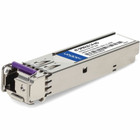








AddOn AT-SPBD10-14-AO Compatible TAA 1000Base-BX SFP Transceiver - Singlemode - 1490nmTx/1310nmRx - 10km - LC - DOM

Business volume discounts
Technical guidance
Preparation & staging
QC · ON · AB · BC
Product Features
Technical Overview
This SFP transceiver operates on the 1000Base-BX standard, providing a full-duplex Gigabit Ethernet connection at 1 Gbps data transfer rates. It utilizes singlemode optical fiber media, which supports longer distance transmissions with lower attenuation compared to multimode alternatives.
The module incorporates Digital Optical Monitoring (DOM) functionality, allowing for real-time diagnostics of optical power, temperature, and voltage. This feature enhances network manageability by providing visibility into transceiver performance and health.
This section brings together practical product details such as Application/Usage, Total Number of Ports, Connector Type, Interfaces/Ports Details, so buyers can judge configuration, deployment fit, and day-to-day suitability with less guesswork.
A strong technical summary explains how the product's interfaces, hardware profile, and operating characteristics work together in real deployment. Buyers often need this context to confirm compatibility with existing devices, expected performance in daily use, and whether installation will be straightforward for IT staff or end users.
Key Product Advantages
This transceiver offers several advantages for network deployments requiring reliable, high-performance fiber connectivity.
Bidirectional Efficiency
The 1000Base-BX technology uses a single fiber strand for both transmit and receive signals, reducing fiber count and infrastructure costs while maintaining full Gigabit Ethernet performance.
- 1490nm Tx / 1310nm Rx wavelengths
- Single fiber strand operation
- Up to 10 km reach
Enhanced Monitoring
DOM support provides critical diagnostic data, enabling proactive maintenance and troubleshooting without physical inspection of the fiber link.
- Real-time optical power monitoring
- Temperature and voltage diagnostics
- Improved network visibility
Deployment / Use Cases
This SFP transceiver is suitable for various networking scenarios where reliable, medium-distance fiber connectivity is required. Its compatibility with Allied Telesis switches and MSA-compliant equipment makes it adaptable to diverse network architectures.
Common applications include connecting network switches across buildings in campus environments, linking network segments in industrial settings, and extending network reach in service provider access networks. The 10 km distance capability supports connections between geographically separated nodes without requiring intermediate equipment.
Enterprise Network Expansion
Connect switches between buildings or floors using existing singlemode fiber infrastructure, extending network reach while maintaining Gigabit Ethernet performance.
Service Provider Access
Deploy in access networks to connect customer premises equipment to central offices, leveraging the 10 km distance for suburban or small town coverage.
Physical Profile
The transceiver features a compact SFP form factor with dimensions of 2.75" (69.85 mm) wide × 4.75" (120.65 mm) deep × 1.20" (30.48 mm) high, weighing approximately 6.40 oz (181.44 g). This standardized size ensures compatibility with SFP slots in switches and routers, supporting hot-pluggable installation for easy maintenance and upgrades without network downtime.
- Width
- 2.75" (69.85 mm)
- Depth
- 4.75" (120.65 mm)
- Height
- 1.20" (30.48 mm)
- Weight
- 6.40 oz (181.44 g)
Highlights
- 1000Base-BX Gigabit Ethernet SFP transceiver for singlemode fiber
- 1490nm transmit and 1310nm receive wavelengths for bidirectional operation
- 10 kilometer maximum reach distance
- LC connector interface for standard fiber patch cables
- DOM (Digital Optical Monitoring) for real-time diagnostics
- MSA-compliant design for broad equipment compatibility
- TAA (Trade Agreements Act) compliant
- 3-year limited warranty for added reliability assurance
Specifications
| Specifications | |
|---|---|
| Manufacturer | AddOn |
| Manufacturer Part Number | AT-SPBD10-14-AO |
| Brand Name | AddOn |
| Product Name | SFP Module |
| Product Type | SFP |
| Technical Information | |
| Application/Usage | Optical Network,Data Networking |
| Interfaces/Ports | |
| Total Number of Ports | 1 |
| Connector Type | LC |
| Interfaces/Ports Details | 1 x LC 1000Base-BX Network |
| Media & Performance | |
| Media Type Supported | Optical Fiber |
| Fiber Mode Supported | Single-mode |
| Ethernet Technology | Gigabit Ethernet |
| Network Technology | 1000Base-BX |
| Maximum Data Transfer Rate | 1 |
| Physical Characteristics | |
| Height | 1.20" (30.48 mm) |
| Width | 2.75" (69.85 mm) |
| Depth | 4.75" (120.65 mm) |
| Weight (Approximate) | 6.40 oz (181.44 g) |
| Miscellaneous | |
| Country of Origin | United States |
| Warranty | |
| Limited Warranty | 3 Year |
User Manual
FAQ
What is the difference between 1000Base-BX and standard 1000Base-LX SFP transceivers?
1000Base-BX transceivers use bidirectional technology that transmits and receives on different wavelengths over a single fiber strand, while 1000Base-LX typically uses two separate fibers. This BX technology reduces fiber count requirements by 50% while maintaining full Gigabit Ethernet performance, making it cost-effective for infrastructure with limited fiber availability.
What networking equipment is this SFP transceiver compatible with?
This MSA-compliant transceiver is compatible with a wide range of Allied Telesis switches including the 8000S, 8100L, 8100S, 8600, 9000, x600, and x610 series, as well as other MSA-compliant networking equipment. The compatibility list includes models like AT-8000S/16, AT-8100S/24, AT-9000/28, and AT-x600-24Ts, among others. Always verify specific switch compatibility before deployment.
How does DOM (Digital Optical Monitoring) benefit network management?
DOM provides real-time diagnostic monitoring of key transceiver parameters including optical transmit and receive power, temperature, and supply voltage. This enables network administrators to monitor link health, detect potential issues before they cause outages, and troubleshoot problems remotely without physical inspection. DOM data is typically accessible through switch management interfaces.
What type of fiber patch cables should I use with this transceiver?
This transceiver requires singlemode fiber patch cables with LC connectors. The 10 km reach is achieved with standard singlemode fiber (OS1/OS2). For optimal performance, ensure patch cables are properly terminated and cleaned, and verify that the total link loss including connectors and splices does not exceed the transceiver's budget for the 10 km distance.
Can this transceiver be used for multimode fiber applications?
No, this transceiver is specifically designed for singlemode fiber applications only. Using it with multimode fiber would result in excessive signal loss and unreliable operation. For multimode fiber requirements, you would need a different transceiver model specifically engineered for multimode media with appropriate wavelength and distance specifications.
What does TAA compliance mean for this product?
TAA (Trade Agreements Act) compliance indicates that this product meets the requirements for U.S. government procurement under trade agreements. This means the transceiver is manufactured or substantially transformed in a designated country, making it eligible for purchase by federal agencies and contractors subject to TAA regulations. For commercial users, TAA compliance often indicates quality manufacturing standards.
| Qty | Price | Available |
|---|