






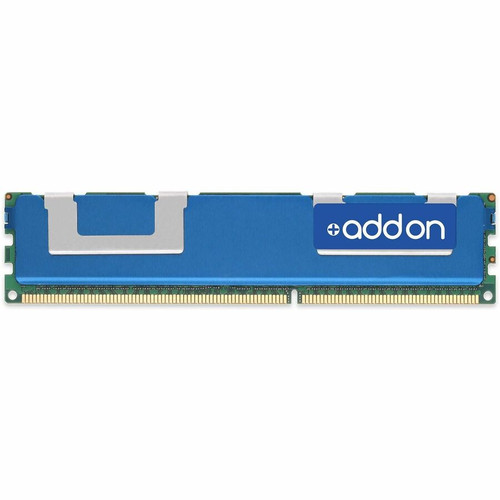
AddOn SNPM39YFC/32G-AM 32GB DDR3-1333MHz LRDIMM ECC Quad Rank x4 1.35V 240-pin CL9 Server Memory

Business volume discounts
Technical guidance
Preparation & staging
QC · ON · AB · BC
Product Features
Product Overview
The AddOn SNPM39YFC/32G-AM is a 32GB DDR3 server memory module engineered for high-density enterprise environments. Built as a Load-Reduced DIMM (LRDIMM) with quad-rank x4 architecture, this module delivers substantial memory capacity while maintaining efficient power consumption at 1.35V. Its ECC (Error-Correcting Code) functionality ensures data integrity for mission-critical applications where reliability is non-negotiable.
Designed with a 240-pin interface and DDR3-1333/PC3-10600 standard, this memory operates at 1333 MHz with CL9 latency, balancing speed with stable performance. The module is specifically configured as a factory-original compatible solution for Dell server systems, providing a direct upgrade path for existing infrastructure without compatibility concerns. Its LRDIMM design reduces electrical load on the memory controller, enabling higher module counts per channel in supported servers.
Relevant factors for this section include Memory Size, Memory Technology, Memory Voltage, Number of Pins. When those points are considered together, they give buyers a clearer picture of how the product is equipped, how it fits into deployment, and what kind of day-to-day role it is meant to support.
Technical Overview
This memory module implements DDR3 SDRAM technology with a 1333 MHz clock speed, corresponding to the DDR3-1333/PC3-10600 standard. The quad-rank x4 architecture organizes memory cells across four ranks with four-bit prefetch, optimizing data throughput for server workloads. ECC support automatically detects and corrects single-bit memory errors, preventing data corruption and system crashes.
The 1.35V operating voltage represents a power-efficient design compared to standard 1.5V DDR3 modules, reducing thermal output and energy consumption in densely populated server racks. The CL9 (CAS Latency 9) timing ensures responsive memory access with minimal delay between command and data availability. These technical specifications combine to deliver reliable, high-capacity memory performance for demanding server applications.
Relevant factors for this section include Memory Size, Memory Technology, Memory Voltage, Number of Pins. When those points are considered together, they give buyers a clearer picture of how the product is equipped, how it fits into deployment, and what kind of day-to-day role it is meant to support.
Key Product Advantages
High-Density Server Memory
With 32GB capacity in a single LRDIMM module, this memory enables substantial memory expansion in server systems. The quad-rank architecture maximizes memory density while maintaining compatibility with server memory controllers designed for high-capacity modules.
- 32GB per module reduces slot usage
- Quad-rank design optimizes density
- LRDIMM reduces electrical load per channel
Enterprise-Grade Reliability
ECC functionality provides continuous error detection and correction, essential for database servers, virtualization hosts, and other critical infrastructure. The 1.35V low-voltage operation reduces power consumption and heat generation in 24/7 environments.
- ECC protects against data corruption
- 1.35V reduces power draw by ~10%
- Factory-tested for server compatibility
Deployment / Use Cases
This DDR3 LRDIMM is engineered for Dell server platforms requiring high-capacity, reliable memory expansion. Its specific configuration makes it ideal for aging server infrastructure that still delivers business value but needs memory upgrades to handle modern workloads. The module serves as a cost-effective alternative to complete server replacement when memory constraints limit performance.
Primary deployment scenarios include database servers handling large datasets, virtualization hosts running multiple virtual machines, and application servers processing high-volume transactions. The ECC protection is particularly valuable for financial systems, healthcare databases, and scientific computing where data accuracy is paramount. The LRDIMM form factor enables maximum memory population in servers designed for load-reduced modules, making it suitable for memory-intensive applications like in-memory databases, data analytics platforms, and high-performance computing clusters.
Server Memory Expansion
Upgrade existing Dell servers to handle larger datasets and more concurrent users without replacing entire systems. The compatible design ensures seamless integration with supported server platforms.
- Extend lifespan of Dell server hardware
- Increase virtual machine density
- Handle larger database workloads
Data Center Efficiency
The 1.35V operation reduces power consumption in densely populated server racks, lowering operational costs while maintaining performance. ECC ensures continuous operation without data corruption concerns.
- Reduce server power consumption
- Maintain 24/7 reliability with ECC
- Optimize existing server investment
Physical Profile
The module measures 5.50" (139.70 mm) in length, 1.50" (38.10 mm) in width, and 0.30" (7.62 mm) in thickness, conforming to standard LRDIMM dimensions for server compatibility. Weighing approximately 8 oz (226.80 g), it maintains a balanced profile for secure installation in server memory slots. The 240-pin edge connector interfaces directly with server motherboard slots designed for DDR3 LRDIMM modules, ensuring proper physical and electrical connection.
- Width
- 1.50" (38.10 mm)
- Weight
- 8 oz (226.80 g)
- Length
- 5.50" (139.70 mm)
Highlights
- 32GB DDR3-1333MHz memory capacity for server applications
- LRDIMM (Load-Reduced DIMM) form factor with 240-pin interface
- ECC (Error-Correcting Code) for data integrity protection
- Quad-rank x4 architecture optimized for high-density memory
- 1.35V low-voltage operation reduces power consumption
- CL9 latency for responsive memory access
- Factory-original compatible design for Dell server systems
- Standard LRDIMM dimensions: 5.50" × 1.50" × 0.30"
- Single module configuration (1 × 32GB)
- Lifetime limited warranty for long-term reliability
Specifications
| Specifications | |
|---|---|
| Manufacturer | AddOn |
| Manufacturer Part Number | SNPM39YFC/32G-AM |
| Brand Name | AddOn |
| Product Name | 32 GB DDR3 SDRAM Memory Module |
| Packaged Quantity | 1 |
| Product Type | RAM Module |
| Technical Information | |
| Memory Size | 32 GB |
| Memory Technology | DDR3 SDRAM |
| Memory Voltage | 1.35 V |
| Number of Modules | 1 x 32GB |
| Memory Speed | 1333 MHz |
| Memory Standard | DDR3-1333/PC3-10600 |
| Memory Rank | Quad-rank |
| Error Checking | ECC |
| CAS Latency | CL9 |
| Physical Characteristics | |
| Number of Pins | 240-pin |
| Form Factor | LRDIMM |
| Thickness | 0.30" (7.62 mm) |
| Width | 1.50" (38.10 mm) |
| Length | 5.50" (139.70 mm) |
| Weight (Approximate) | 8 oz (226.80 g) |
| Miscellaneous | |
| TAA Compliant | No |
| Warranty | |
| Limited Warranty | Lifetime |
FAQ
What type of memory module is the AddOn SNPM39YFC/32G-AM?
This is a 32GB DDR3-1333MHz LRDIMM (Load-Reduced DIMM) server memory module with ECC (Error-Correcting Code) protection. It features a quad-rank x4 architecture, operates at 1.35V, and uses a 240-pin interface with CL9 latency. The LRDIMM form factor is designed specifically for server applications where high memory density and reduced electrical load are priorities.
What does ECC memory provide for server applications?
ECC (Error-Correcting Code) memory automatically detects and corrects single-bit memory errors that can occur during data storage or retrieval. This protection is essential for server environments running critical applications like databases, virtualization platforms, and financial systems where data corruption could cause system crashes, incorrect calculations, or data loss. ECC ensures continuous reliable operation without the need for manual intervention when minor memory errors occur.
How does the quad-rank x4 architecture benefit server performance?
Quad-rank x4 architecture organizes memory cells across four ranks with four-bit prefetch capability. This design increases memory density within a single module while maintaining efficient communication with the memory controller. For servers, this means higher total memory capacity can be achieved with fewer physical modules, reducing slot usage and enabling more memory per channel. The x4 organization refers to the internal memory chip configuration, which is optimized for server workloads requiring high capacity and reliability.
What is the advantage of 1.35V operation compared to standard DDR3 voltage?
Operating at 1.35V instead of the standard 1.5V for DDR3 memory reduces power consumption by approximately 10% and decreases heat generation. This is particularly valuable in server environments where multiple memory modules operate continuously in confined spaces. Lower voltage extends component lifespan, reduces cooling requirements, and lowers electricity costs in data center deployments while maintaining full DDR3-1333MHz performance with CL9 latency.
What systems are compatible with this LRDIMM memory module?
This module is designed as a factory-original compatible solution for Dell server systems that support DDR3 LRDIMM memory. Compatibility depends on specific server models and their memory controllers supporting 32GB LRDIMM modules with 1333MHz speed, quad-rank architecture, and 1.35V operation. Users should verify their server's technical specifications and qualified vendor lists to ensure compatibility before installation, as LRDIMMs require specific memory controller support different from standard RDIMMs or UDIMMs.
What does the lifetime limited warranty cover for this memory module?
The lifetime limited warranty provides coverage against defects in materials and workmanship for the functional life of the product. This typically means the module is protected as long as it remains in use, offering long-term assurance for server deployments where memory reliability is critical. The warranty applies to the original purchaser and covers replacement or repair of modules that fail under normal use conditions, excluding physical damage, improper installation, or use in incompatible systems.
| Qty | Price | Available |
|---|