




Shipping included*
Exclusions
Additional shipping fees may apply in rare circumstances for deliveries outside standard service areas. In most cases, this only potentially affects shipments to the Northwest Territories and Yukon, as well as certain heavy or oversized items.
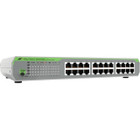
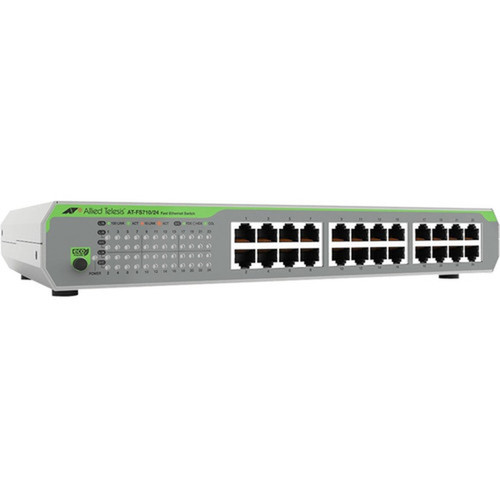
Allied Telesis AT-FS710/24-10 Ethernet Switch - 24 Port Fast Ethernet Desktop - Layer 2 Unmanaged - 10/100Base-TX

Business volume discounts
Technical guidance
Preparation & staging
QC · ON · AB · BC
Product Features
Technical Overview
This switch employs Fast Ethernet technology with 10/100Base-TX network support across all 24 ports. The twisted pair media compatibility allows use with standard Category 5 or better Ethernet cables, supporting data transfer rates up to 100 Mbps per port with a maximum cable distance of 100 meters.
The switching architecture provides store-and-forward switching with automatic speed negotiation and auto-MDI/MDIX crossover detection. With a switching capacity of 4.8 Gbps and a forwarding rate of 3.57 Mpps, the AT-FS710/24-10 handles typical office network traffic efficiently while maintaining low latency.
Relevant factors for this section include Total Number of Network Ports, Uplink Port, Modular, Media Type Supported. When those points are considered together, they give buyers a clearer picture of how the product is equipped, how it fits into deployment, and what kind of day-to-day role it is meant to support.
Key Product Advantages
The AT-FS710/24-10 combines practical connectivity with energy-efficient operation, making it an economical choice for expanding wired networks without complexity.
Simplified Deployment
As an unmanaged switch, this device requires no configuration or management software. Simply connect devices and power on for immediate network expansion.
- Plug-and-play operation
- No software licensing required
- Zero configuration needed
Energy Efficient Design
With a maximum power consumption of just 5.30 watts, this switch minimizes operating costs while meeting environmental standards including RoHS, REACH, and WEEE compliance.
- Low power draw reduces electricity costs
- Meets environmental regulations
- Built-in power supply for reliability
Compact Footprint
The desktop form factor measures 12" wide × 7.09" deep × 1.73" high, fitting easily in space-constrained environments outside traditional wiring closets.
- Slim 1.73" profile
- Lightweight at 3.53 lb
- No rack mounting required
Deployment / Use Cases
The AT-FS710/24-10 serves as an ideal connectivity solution for environments where simplicity and cost-effectiveness take priority over advanced management features. Its 24-port configuration provides sufficient density for small to medium-sized workgroups while maintaining a compact physical presence.
Common deployment scenarios include retail point-of-sale systems, small office workgroups, classroom environments, and home office networks where multiple wired devices need reliable connectivity without network administration overhead.
Relevant factors for this section include Total Number of Network Ports, Uplink Port, Modular, Media Type Supported. When those points are considered together, they give buyers a clearer picture of how the product is equipped, how it fits into deployment, and what kind of day-to-day role it is meant to support.
Small Office Expansion
Add wired connectivity for up to 24 devices in offices where wireless coverage is insufficient or where wired reliability is preferred for critical workstations and network printers.
Retail & Hospitality
Connect POS terminals, inventory scanners, digital signage, and back-office computers in retail environments where stable wired connections support business operations.
Physical Profile
The desktop enclosure features a durable plastic construction with integrated mounting feet for stable placement on horizontal surfaces. The compact dimensions (12" W × 7.09" D × 1.73" H) and lightweight design (3.53 lb) allow flexible placement on desks, shelves, or countertops without requiring dedicated rack space.
- Width
- 12" (304.80 mm)
- Depth
- 7.09" (180.09 mm)
- Height
- 1.73" (43.94 mm)
- Weight
- 3.53 lb (1600 g)
Highlights
- 24 Fast Ethernet ports for connecting multiple wired devices
- Layer 2 switching support for efficient local network traffic
- Unmanaged operation with zero configuration required
- Desktop form factor ideal for space-constrained environments
- Low 5.30W power consumption for energy-efficient operation
- Twisted pair media support with 100-meter cable distance
- 10/100Base-TX network technology with auto-negotiation
- Environmental compliance with RoHS, REACH, and WEEE standards
Specifications
| Specifications | |
|---|---|
| Manufacturer | Allied Telesis, Inc |
| Manufacturer Part Number | AT-FS710/24-10 |
| Brand Name | Allied Telesis |
| Product Line | CentreCOM |
| Product Model | AT-FS710/24 |
| Product Name | AT-FS710/24 Ethernet Switch |
| Product Type | Ethernet Switch |
| Interfaces/Ports | |
| Total Number of Network Ports | 24 |
| Uplink Port | No |
| Modular | No |
| Stack Port | No |
| Port/Expansion Slot Details | 24 x Fast Ethernet Network |
| Media & Performance | |
| Media Type Supported | Twisted Pair |
| Ethernet Technology | Fast Ethernet |
| Network Technology | 10/100Base-TX |
| Network & Communication | |
| Layer Supported | 2 |
| Management & Protocols | |
| Manageable | No |
| Power Description | |
| Power Source | Power Supply |
| Redundant Power Supply Supported | No |
| Power Consumption | 5.30 W |
| Physical Characteristics | |
| Form Factor | Desktop |
| Height | 1.73" (43.94 mm) |
| Width | 12" (304.80 mm) |
| Depth | 7.09" (180.09 mm) |
| Weight (Approximate) | 3.53 lb (1600 g) |
| Miscellaneous | |
| Environmentally Friendly | Yes |
| Environmental Compliance | Restriction of Hazardous Substances (RoHS),Registration, Evaluation, Authorization and Restriction of Chemicals (REACH),Waste Electrical and Electronic Equipment Directive (WEEE) |
| Country of Origin | China |
FAQ
How many devices can I connect to this switch?
The Allied Telesis AT-FS710/24-10 provides 24 Fast Ethernet ports, allowing you to connect up to 24 wired devices simultaneously. This includes computers, printers, IP phones, security cameras, and other network-enabled equipment that requires reliable wired connectivity.
Does this switch support Power over Ethernet (PoE)?
No, this switch does not provide Power over Ethernet capabilities. All 24 ports are standard Fast Ethernet data ports that require connected devices to have their own separate power sources. For PoE requirements, you would need to select a different switch model specifically designed with PoE support.
What is the difference between managed and unmanaged switches?
This AT-FS710/24-10 is an unmanaged switch, meaning it operates automatically without configuration options, management interfaces, or monitoring capabilities. Unmanaged switches like this one provide basic plug-and-play connectivity, while managed switches offer features like VLANs, QoS, port monitoring, and security controls that require configuration and administration.
What type of Ethernet cables work with this switch?
This switch supports standard twisted pair Ethernet cables, specifically Category 5, 5e, or 6 cables with RJ45 connectors. The Fast Ethernet technology supports data transfer at speeds up to 100 Mbps with a maximum cable length of 100 meters (328 feet) between the switch and connected devices.
Can this switch be rack-mounted?
No, the AT-FS710/24-10 features a desktop form factor designed for placement on horizontal surfaces like desks, shelves, or countertops. It does not include rack mounting brackets or a rack-mountable chassis. For rack deployment, you would need to select a switch specifically designed with rack ears and appropriate form factor.
What is Layer 2 switching and why does it matter?
Layer 2 switching refers to data link layer functionality that uses MAC addresses to forward network traffic between devices on the same local network. This AT-FS710/24-10 provides Layer 2 switching capabilities, which means it can efficiently direct traffic between connected devices based on their hardware addresses, reducing unnecessary network broadcast traffic and improving local network performance compared to simple hubs.
| Qty | Price | Available |
|---|