





Shipping included*
Exclusions
Additional shipping fees may apply in rare circumstances for deliveries outside standard service areas. In most cases, this only potentially affects shipments to the Northwest Territories and Yukon, as well as certain heavy or oversized items.
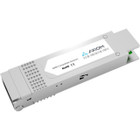
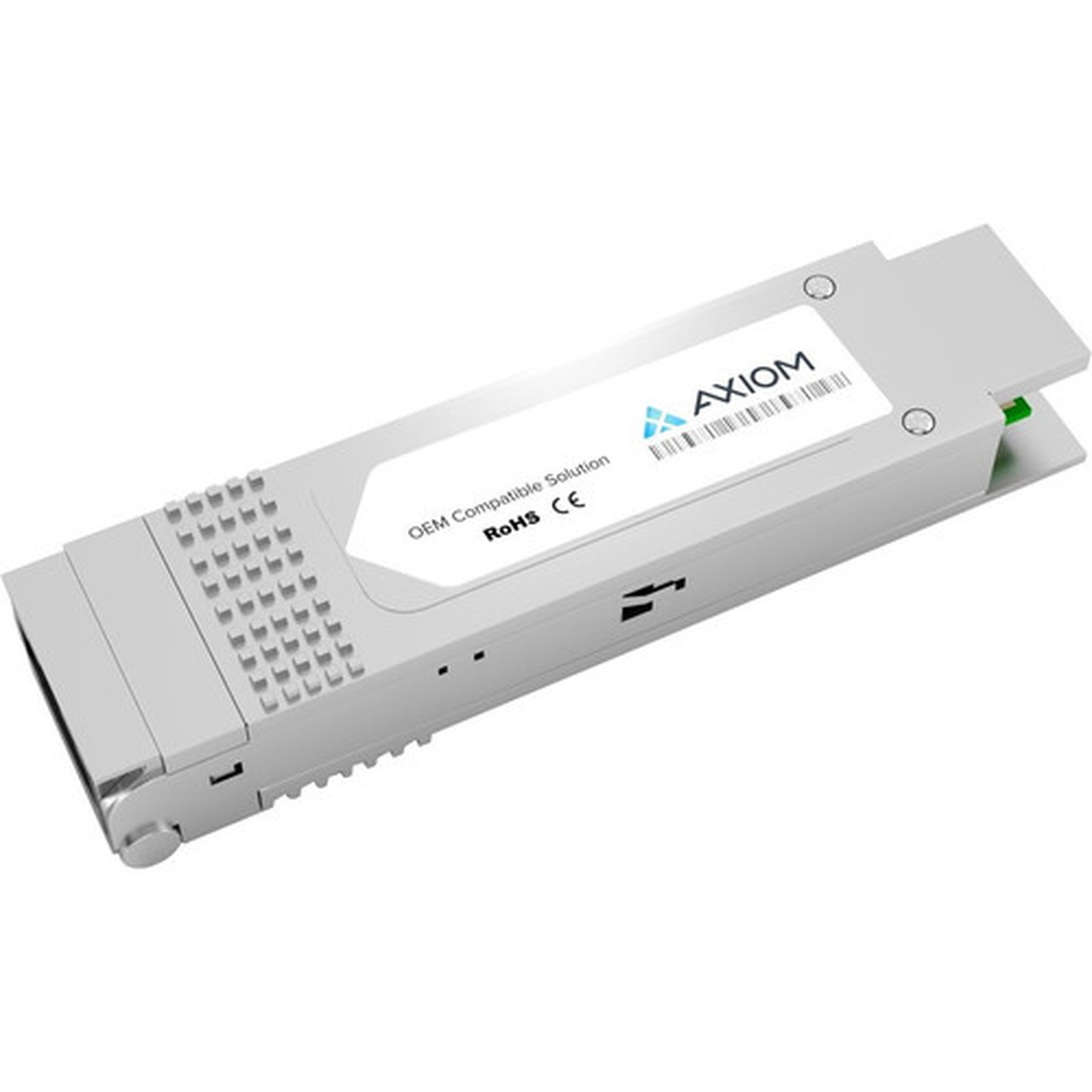
AXIOM MEMORY 40G-QSFP-SR4-AX Axiom 40GBASE-SR4 QSFP+ Transceiver for Brocade - MPO Multi-mode Fiber - MSA Compliant

Business volume discounts
Technical guidance
Preparation & staging
QC · ON · AB · BC
Product Features
Technical Overview
This QSFP+ transceiver operates on the 40GBASE-SR4 standard, utilizing four parallel 10 Gbps lanes to achieve an aggregate data rate of 40 Gbps. It interfaces with multi-mode fiber optic cables through an MPO connector, supporting high-bandwidth data transfers with minimal signal loss over short distances.
The module is engineered for low power consumption and efficient thermal performance, reducing overall energy usage in high-density switch deployments. Its compact form factor allows for maximum port density in network switches and routers, optimizing rack space utilization.
Key Product Advantages
This transceiver offers several advantages for network administrators seeking reliable 40 Gigabit connectivity. Its Brocade compatibility ensures seamless integration into existing network infrastructures, while MSA compliance guarantees broad hardware interoperability.
High-Performance Connectivity
Delivers 40 Gigabit Ethernet speeds with minimal latency, supporting data-intensive applications and high-throughput network segments.
- 40 Gbps aggregate data rate
- Low power consumption design
- Optimized for short-range multi-mode fiber
Reliable Optical Performance
Utilizes multi-mode fiber technology to provide durable connections with excellent signal integrity over appropriate distances.
- MPO connector for parallel optics
- Minimal signal loss characteristics
- Stable performance in data center environments
Deployment / Use Cases
This QSFP+ transceiver is ideal for connecting switches, routers, and servers within data centers, campus networks, and enterprise backbones. It serves as a cost-effective solution for upgrading network segments to 40 Gigabit speeds without requiring extensive infrastructure changes.
Common deployment scenarios include spine-leaf network architectures, high-performance computing clusters, storage area network connections, and aggregation links between network distribution layers. The module's compatibility with Brocade equipment makes it particularly valuable for organizations standardized on Brocade networking solutions.
Data Center Interconnect
Connect top-of-rack switches to aggregation switches in high-density server environments, supporting virtualization and cloud workloads.
Network Backbone Upgrades
Modernize existing network cores with 40 Gigabit capabilities while maintaining compatibility with current multi-mode fiber infrastructure.
Physical Profile
The transceiver measures 0.53 inches in height, 0.72 inches in width, and 2.85 inches in depth, with a weight of approximately 3.52 ounces. This compact design enables high port density in network equipment while maintaining proper airflow for thermal management. The module meets RoHS environmental standards, containing no hazardous substances restricted under international regulations.
- Width
- 0.72" (18.40 mm)
- Depth
- 2.85" (72.40 mm)
- Height
- 0.53" (13.50 mm)
- Weight
- 3.52 oz (99.79 g)
Highlights
- 40 Gigabit Ethernet QSFP+ transceiver for Brocade compatibility
- MPO connector for multi-mode fiber optic connections
- MSA compliant for broad hardware interoperability
- Supports 40GBASE-SR4 standard with four 10 Gbps lanes
- Compact form factor for high-density network deployments
- RoHS certified with environmentally friendly construction
- Low power consumption design for energy efficiency
- Ideal for data center and enterprise network applications
Specifications
| Specifications | |
|---|---|
| Manufacturer | Axiom Memory Solutions |
| Manufacturer Part Number | 40G-QSFP-SR4-AX |
| Brand Name | Axiom |
| Product Model | 40G-QSFP-SR4-AX |
| Product Name | 40GBASE-SR4 QSFP+ Transceiver for Brocade - 40G-QSFP-SR4 |
| Product Type | QSFP+ |
| Technical Information | |
| Application/Usage | Data Networking,Optical Network |
| Interfaces/Ports | |
| Total Number of Ports | 1 |
| Connector Type | MPO |
| Interfaces/Ports Details | 1 x MPO 40GBASE-SR4 Network |
| Media & Performance | |
| Media Type Supported | Optical Fiber |
| Fiber Mode Supported | Multi-mode |
| Ethernet Technology | 40 Gigabit Ethernet |
| Physical Characteristics | |
| Height | 0.53" (13.50 mm) |
| Width | 0.72" (18.40 mm) |
| Depth | 2.85" (72.40 mm) |
| Weight (Approximate) | 3.52 oz (99.79 g) |
| Miscellaneous | |
| Compatibility | MSA Compliant |
| Environmentally Friendly | Yes |
| Environmental Compliance | Restriction of Hazardous Substances (RoHS) |
FAQ
What type of fiber does this QSFP+ transceiver support?
This transceiver supports multi-mode fiber optic cables. Multi-mode fiber features a thicker core diameter that carries multiple light wavelengths, making it suitable for short-range high-bandwidth applications like data center interconnects and campus network backbones.
Is this transceiver compatible with non-Brocade equipment?
Yes, the transceiver is MSA (Multi-Source Agreement) compliant, which ensures interoperability with networking equipment from various manufacturers that adhere to the QSFP+ standard. While specifically tested for Brocade compatibility, it should work with any MSA-compliant 40GBASE-SR4 QSFP+ port.
What is the maximum distance supported by this transceiver?
As a 40GBASE-SR4 transceiver designed for multi-mode fiber, it supports short-range connections typically up to 100 meters on OM3 fiber or 150 meters on OM4 fiber. The exact distance depends on fiber quality and network conditions, but it's optimized for data center and intra-building applications.
Does this transceiver require external power?
No, QSFP+ transceivers receive power directly from the network equipment they're installed in, such as switches or routers. They draw minimal power through the host device's QSFP+ port, making them energy-efficient components in network infrastructure.
| Qty | Price | Available |
|---|