





Shipping included*
Exclusions
Additional shipping fees may apply in rare circumstances for deliveries outside standard service areas. In most cases, this only potentially affects shipments to the Northwest Territories and Yukon, as well as certain heavy or oversized items.
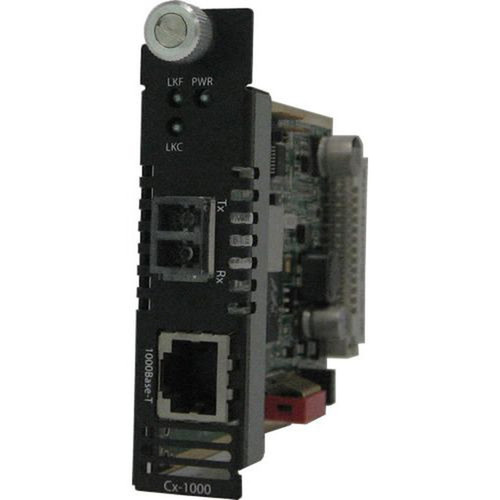
Perle 05051800 C-1000-S2LC160 Gigabit Ethernet Media Converter - 1 x RJ-45 & 1 x LC Ports - 1000Base-T/ZX - 160 km - Internal

Business volume discounts
Technical guidance
Preparation & staging
QC · ON · AB · BC
Product Features
Technical Overview
This media converter operates at Layer 1, performing transparent electrical-to-optical signal conversion without protocol modification. It features auto-negotiation on the RJ-45 port for speed and duplex matching with connected Ethernet devices, while the LC port supports 1000Base-ZX for long-haul fiber connections.
The internal design allows for direct installation within network racks or enclosures, minimizing footprint and simplifying cable management. With a lightweight 150-gram construction, it imposes minimal physical load while supporting environmentally conscious deployment.
Key Product Advantages
The C-1000-S2LC160 eliminates distance limitations of copper cabling by leveraging fiber optic technology, while maintaining compatibility with standard Ethernet equipment. Its plug-and-play operation requires no configuration, reducing deployment time and technical overhead.
Extended Network Reach
Support for 160 km fiber distances enables connectivity between geographically separated sites without signal degradation or repeaters.
- Eliminates copper distance limits
- Maintains Gigabit performance over long runs
- Reduces infrastructure costs for remote connections
Seamless Media Integration
Converts between RJ-45 copper and LC fiber interfaces transparently, allowing mixed-media networks without protocol changes.
- Preserves Ethernet frame structure
- Auto-negotiates with connected devices
- Supports standard network management
Deployment / Use Cases
This media converter is engineered for scenarios requiring extended network distances or fiber backbone integration. It serves as a cost-effective solution for connecting remote offices, campus buildings, or industrial facilities where direct copper runs are impractical.
Common applications include extending LAN segments across large facilities, connecting network equipment in separate buildings, integrating fiber optic backbones into existing copper networks, and providing noise immunity in electrically noisy environments. The internal form factor makes it suitable for rack-mounted installations in data centers, telecom closets, or industrial control panels.
Remote Office Connectivity
Connect branch offices or remote buildings over fiber infrastructure while maintaining Ethernet compatibility at both ends.
Fiber Backbone Integration
Incorporate high-speed fiber segments into copper-based networks without replacing existing switches or routers.
Physical Profile
Designed for internal installation, this media converter features a compact form factor that integrates neatly into network racks or enclosures. The 150-gram weight minimizes structural load while the design supports efficient heat dissipation in confined spaces. The environmentally friendly construction and Canadian origin reflect sustainable manufacturing practices.
- Weight
- 150 g
Highlights
- Converts between RJ-45 copper and LC fiber interfaces for seamless media integration
- Supports 1000Base-T and 1000Base-ZX standards for full Gigabit performance
- Extends network distances up to 160 kilometers over single-mode fiber
- Internal form factor for rack or enclosure mounting with minimal footprint
- Lightweight 150-gram design reduces installation load
- Auto-negotiation on RJ-45 port ensures compatibility with Ethernet devices
- Environmentally friendly construction with Canadian origin
- Lifetime warranty provides long-term reliability assurance
Specifications
| Specifications | |
|---|---|
| Manufacturer | Perle Systems, Inc |
| Manufacturer Part Number | 05051800 |
| Brand Name | Perle |
| Product Model | C-1000-S2LC160 |
| Product Name | C-1000-S2LC160 Gigabit Ethernet Media Converter |
| Product Type | Transceiver/Media Converter |
| Interfaces/Ports | |
| Total Number of Ports | 2 |
| Network (RJ-45) | Yes |
| Number of LC Ports | 1 |
| Number of Network (RJ-45) Ports | 1 |
| Media & Performance | |
| Maximum Distance Supported | 160 km |
| Network & Communication | |
| Network Technology | 1000Base-T,1000Base-ZX |
| Physical Characteristics | |
| Form Factor | Internal |
| Weight (Approximate) | 150 g |
| Miscellaneous | |
| Environmentally Friendly | Yes |
| Country of Origin | Canada |
| Warranty | |
| Limited Warranty | Lifetime |
FAQ
What types of network connections does this media converter support?
This converter supports one RJ-45 port for standard copper Ethernet connections and one LC port for fiber optic connections. It converts between 1000Base-T over twisted pair cable and 1000Base-ZX over single-mode fiber, enabling seamless integration of fiber segments into copper networks.
What is the maximum distance supported by the fiber connection?
The LC fiber port supports distances up to 160 kilometers when using single-mode fiber with 1000Base-ZX technology. This extended reach makes it suitable for connecting remote buildings, campus networks, or geographically separated facilities without signal degradation.
How is this media converter installed and powered?
This converter features an internal form factor designed for installation within network racks, enclosures, or equipment cabinets. It receives power through standard internal power connections typical for rack-mounted devices, requiring minimal energy and effort for deployment in structured network environments.
What are the key differences between 1000Base-T and 1000Base-ZX?
1000Base-T operates over Category 5e or better copper cabling with a maximum distance of 100 meters, while 1000Base-ZX operates over single-mode fiber with distances up to 160 kilometers. This converter translates between these media types, allowing copper devices to communicate over long fiber runs.
| Qty | Price | Available |
|---|