








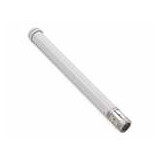

Cisco AIR-ANT2450V-N= Aironet Omni-directional Antenna - 5 dBi Gain - 2. 4 GHz UHF - N-Type Connector

Business volume discounts
Technical guidance
Preparation & staging
QC · ON · AB · BC
Product Features
Technical Overview
This antenna operates within the UHF frequency band, specifically tuned for the 2.4 GHz spectrum commonly used in Wi-Fi and other wireless data applications. The 5 dBi isotropic gain provides balanced signal strength for broad coverage areas, while the omni-directional pattern ensures consistent performance in all horizontal directions.
The N-type connector offers a secure, industry-standard interface compatible with many Cisco Aironet access points and similar networking equipment. This connector type supports reliable RF transmission with minimal signal loss, which is critical for maintaining network integrity in professional installations.
This section brings together practical product details such as Directivity, Frequency Band Type, Operating Frequency Range, Connector Type, so buyers can judge configuration, deployment fit, and day-to-day suitability with less guesswork.
A strong technical summary explains how the product's interfaces, hardware profile, and operating characteristics work together in real deployment. Buyers often need this context to confirm compatibility with existing devices, expected performance in daily use, and whether installation will be straightforward for IT staff or end users.
Key Product Advantages
For buyers comparing similar models, the strongest advantage is usually the balance between dependable day-to-day operation and a simpler rollout experience. That means less time spent troubleshooting fit, compatibility, or user adoption after installation, which is especially important for shared business environments and repeat purchasing decisions.
Advantages are also easier to justify when they translate into measurable operational value, such as less downtime, more consistent user experience, easier replacement planning, or better alignment with existing accessories and workflows. That practical value tends to matter more than broad marketing language when teams are standardizing purchases.
Deployment / Use Cases
This section brings together practical product details such as Directivity, Frequency Band Type, Operating Frequency Range, Connector Type, so buyers can judge configuration, deployment fit, and day-to-day suitability with less guesswork.
Deployment planning benefits from clear examples of where the product fits best, how it may be installed or used, and which business scenarios it supports most naturally. This helps teams judge whether the product belongs at a fixed desk, in a shared workspace, in a meeting area, or as part of a broader managed device rollout.
Office and Commercial Wi-Fi Extension
Ideal for expanding Wi-Fi coverage in offices, retail spaces, or warehouses where omni-directional signal propagation supports multiple client devices across open floor plans.
- Supports 2.4 GHz Wi-Fi networks
- Easily mounts on ceilings or walls
- Complements Cisco Aironet access points
Wireless Infrastructure Upgrades
Use as a replacement or upgrade antenna for existing Cisco wireless deployments to improve signal quality and reliability without replacing entire access points.
- Direct compatibility with N-type ports
- Maintains existing network management frameworks
- Minimizes downtime during upgrades
Physical Profile
Measuring 11 inches in height with a 1-inch square cross-section, this antenna features a slender profile that minimizes visual impact in installed environments. The lightweight construction at 6.30 ounces simplifies handling during installation and reduces stress on mounting hardware.
The compact dimensions allow for discreet placement in ceiling mounts, wall brackets, or other standard antenna mounting solutions. This physical design supports both indoor and protected outdoor installations where space constraints or aesthetic considerations are important.
- Width
- 1" (25.40 mm)
- Depth
- 1" (25.40 mm)
- Height
- 11" (279.40 mm)
- Weight
- 6.30 oz (178.60 g)
Highlights
- Omni-directional pattern for 360-degree coverage
- 5 dBi isotropic gain enhances signal strength
- UHF frequency band optimized for 2.4 GHz operations
- N-type connector for reliable RF connections
- Compact 11" height with 1" × 1" footprint
- Lightweight at 6.30 oz for easy installation
- Designed for wireless data network applications
- 1-year limited warranty from Cisco
Specifications
| Specifications | |
|---|---|
| Manufacturer | Cisco Systems, Inc |
| Manufacturer Part Number | AIR-ANT2450V-N= |
| Brand Name | Cisco |
| Product Line | Aironet |
| Product Model | AIR-ANT2450V-N= |
| Product Name | Aironet Omni-directional Antenna |
| Product Type | Antenna |
| Technical Information | |
| Directivity | Omni-directional |
| Frequency Band Type | UHF |
| Operating Frequency Range | 2.4 GHz to 2.4 GHz |
| Antenna Gain (Isotropic) | 5 dBi |
| Interfaces/Ports | |
| Connector Type | N-Type |
| Physical Characteristics | |
| Height | 11" (279.40 mm) |
| Width | 1" (25.40 mm) |
| Depth | 1" (25.40 mm) |
| Weight (Approximate) | 6.30 oz (178.60 g) |
| Miscellaneous | |
| Application/Usage | Wireless Data Network |
| Country of Origin | China |
| Warranty | |
| Limited Warranty | 1 Year |
FAQ
What type of wireless networks is this antenna designed for?
The Cisco AIR-ANT2450V-N= antenna is specifically engineered for wireless data networks operating in the 2.4 GHz UHF frequency band. This makes it suitable for Wi-Fi deployments, wireless bridging applications, and other data transmission systems that utilize this common spectrum range. Its omni-directional pattern and 5 dBi gain provide balanced coverage for client devices across commercial and enterprise environments.
What does 'omni-directional' mean for antenna performance?
Omni-directional refers to the antenna's radiation pattern, which transmits and receives signals equally in all horizontal directions. Unlike directional antennas that focus energy in a specific beam, this omni-directional design provides 360-degree coverage, making it ideal for environments where client devices may be located in various positions around the antenna. This simplifies installation since precise directional alignment isn't required.
What is the significance of the 5 dBi gain rating?
The 5 dBi gain indicates how much the antenna amplifies signal strength compared to an isotropic radiator. This moderate gain level provides improved signal reach without creating an excessively narrow beam pattern that would limit coverage area. For the AIR-ANT2450V-N=, this gain balances extended range with the broad coverage of its omni-directional design, making it effective for general wireless data applications.
What equipment is compatible with the N-type connector?
The N-type connector is an industry-standard RF interface compatible with many Cisco Aironet access points and similar professional networking equipment. This threaded connector provides secure mechanical attachment and reliable electrical contact for RF signals, minimizing signal loss at the connection point. It's commonly found on enterprise-grade wireless hardware and supports frequencies up to 11 GHz, making it suitable for 2.4 GHz applications.
How should this antenna be mounted for optimal performance?
This antenna's compact dimensions and omni-directional pattern support flexible mounting options including ceiling mounts, wall brackets, or pole installations. For optimal performance, position the antenna vertically to maximize horizontal coverage, and ensure it's placed away from large metal obstructions that could interfere with signal propagation. The lightweight design simplifies installation on various surfaces while maintaining stability.
What warranty coverage does Cisco provide for this antenna?
Cisco provides a 1-year limited warranty for the AIR-ANT2450V-N= antenna. This warranty covers defects in materials and workmanship under normal use conditions. For complete warranty terms and support procedures, consult Cisco's official documentation or contact their support channels directly with your product serial number and purchase details.
What throughput, switching capacity, or performance detail is listed?
the specifications are intended to help buyers confirm fit, compatibility, and expected day-to-day operation. In practical terms, the best reading of this product comes from how its hardware, connectivity, and deployment details work together.
What uplink, SFP, fiber, or media support detail is listed?
the specifications are intended to help buyers confirm fit, compatibility, and expected day-to-day operation. In practical terms, the best reading of this product comes from how its hardware, connectivity, and deployment details work together.
| Qty | Price | Available |
|---|