








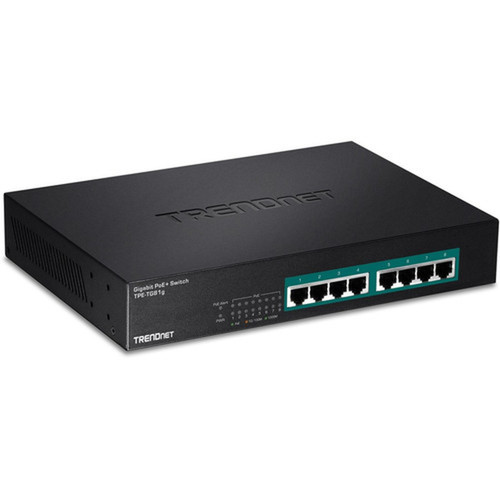



TRENDnet TPE-TG81g 8-Port Gigabit GREENnet PoE+ Switch - Rack Mountable - 110W Total PoE Budget

Business volume discounts
Technical guidance
Preparation & staging
QC · ON · AB · BC
Product Features
Technical Overview
This switch operates as a transparent bridge at Layer 2 of the OSI model, forwarding traffic based on MAC addresses without requiring configuration. All eight ports support 10/100/1000 Mbps speeds with auto-MDI/MDIX crossover detection, eliminating the need for crossover cables.
The 110W total PoE budget enables simultaneous power delivery to multiple PoE+ devices such as wireless access points, IP cameras, VoIP phones, and IoT sensors. Each port can deliver up to 30W following IEEE 802.3at standards, with automatic detection and protection against non-PoE device damage.
Relevant factors for this section include Total Number of Network Ports, Uplink Port, Modular, Media Type Supported. When those points are considered together, they give buyers a clearer picture of how the product is equipped, how it fits into deployment, and what kind of day-to-day role it is meant to support.
Network Performance
The switch provides non-blocking switching with 16 Gbps total throughput capacity, ensuring full wire-speed performance across all ports simultaneously without packet loss under normal operating conditions.
Key Product Advantages
The TPE-TG81g combines essential PoE functionality with deployment-ready features that simplify network expansion in constrained spaces.
For buyers comparing similar models, the strongest advantage is usually the balance between dependable day-to-day operation and a simpler rollout experience. That means less time spent troubleshooting fit, compatibility, or user adoption after installation, which is especially important for shared business environments and repeat purchasing decisions.
Advantages are also easier to justify when they translate into measurable operational value, such as less downtime, more consistent user experience, easier replacement planning, or better alignment with existing accessories and workflows. That practical value tends to matter more than broad marketing language when teams are standardizing purchases.
Deployment / Use Cases
The unmanaged nature and substantial PoE budget make this switch ideal for environments where simplicity and power delivery take priority over advanced management features.
Small business networks benefit from the plug-and-play installation, while retail environments appreciate the ability to power security cameras and wireless access points from a single centralized switch. Educational settings can deploy the switch in classrooms or labs to support PoE-powered devices without complex configuration.
Relevant factors for this section include Total Number of Network Ports, Uplink Port, Modular, Media Type Supported. When those points are considered together, they give buyers a clearer picture of how the product is equipped, how it fits into deployment, and what kind of day-to-day role it is meant to support.
Surveillance Systems
Power up to eight PoE+ IP cameras simultaneously while providing Gigabit connectivity for high-resolution video streaming to network video recorders.
Wireless Network Expansion
Deploy multiple wireless access points throughout a facility while maintaining consistent power and network connectivity from a central rack location.
Physical Profile
Measuring 4" (101.60 mm) in height, 7" (177.80 mm) in width, and 9" (228.60 mm) in depth, the switch occupies minimal rack space while providing full front-to-back airflow. The 1.98 lb weight makes it easy to install in standard 19-inch racks using the included mounting brackets.
The compact design suits network closets, server rooms, and wall-mounted rack enclosures where space optimization matters. All ports are front-accessible, with status LEDs providing at-a-glance monitoring of link activity and PoE delivery.
- Width
- 7" (177.80 mm)
- Depth
- 9" (228.60 mm)
- Height
- 4" (101.60 mm)
- Weight
- 1.98 lb (898.11 g)
- Length
- 10.40" (264.16 mm)
What's in the Box
The switch ships with everything needed for immediate deployment in rack environments.
Package contents include 8-Port Gigabit GREENnet PoE+ Switch Quick Installation Guide Power Cord Rack mount brackets, 8-Port Gigabit GREENnet PoE+ Switch. These included items support setup, installation, and immediate deployment without needing to source the core bundled accessories separately.
Highlights
- 8 Gigabit Ethernet ports with PoE+ support
- 110W total PoE budget for multiple powered devices
- Rack-mountable 1U form factor with included brackets
- Unmanaged Layer 2 switching for plug-and-play operation
- TAA compliant for government and institutional procurement
- Lifetime limited warranty for long-term reliability
- GREENnet technology reduces power consumption
- Supports 10/100/1000 Mbps auto-negotiation on all ports
Specifications
| Specifications | |
|---|---|
| Manufacturer | TRENDnet |
| Manufacturer Part Number | TPE-TG81g |
| Brand Name | TRENDnet |
| Product Model | TPE-TG81G |
| Product Name | 8-port Gigabit GREENnet PoE+ Switch, rack mountable |
| Product Condition | New |
| Product Type | Ethernet Switch |
| Interfaces/Ports | |
| Total Number of Network Ports | 8 |
| Uplink Port | No |
| Modular | No |
| Stack Port | No |
| Port/Expansion Slot Details | 8 x Gigabit Ethernet Network |
| Media & Performance | |
| Media Type Supported | Twisted Pair |
| Ethernet Technology | Gigabit Ethernet |
| Network Technology | 10/100/1000Base-T |
| Network & Communication | |
| Layer Supported | 2 |
| Management & Protocols | |
| Manageable | No |
| Power Description | |
| PoE (RJ-45) Port | No |
| Power Source | Power Supply |
| Redundant Power Supply Supported | No |
| Physical Characteristics | |
| Form Factor | Rack-mountable |
| Height | 4" (101.60 mm) |
| Width | 7" (177.80 mm) |
| Depth | 9" (228.60 mm) |
| Length | 10.40" (264.16 mm) |
| Weight (Approximate) | 1.98 lb (898.11 g) |
| Miscellaneous | |
| Package Contents | 8-Port Gigabit GREENnet PoE+ Switch Quick Installation Guide Power Cord Rack mount brackets |
| Country of Origin | Taiwan |
| TAA Compliant | Yes |
| Warranty | |
| Limited Warranty | Lifetime |
User Manual
FAQ
How many PoE devices can this switch power simultaneously?
The switch can power up to eight PoE+ devices simultaneously, with a total power budget of 110W distributed across all ports. Each port supports IEEE 802.3at PoE+ standard with up to 30W per port, allowing flexibility in powering combinations of devices like IP cameras, wireless access points, and VoIP phones within the total budget constraints.
Is this switch manageable through a web interface or CLI?
No, this is an unmanaged switch that operates as a transparent Layer 2 bridge without configuration interfaces. It provides plug-and-play functionality with automatic features like auto-negotiation, auto-MDI/MDIX, and PoE detection, making it suitable for deployments where simplicity and immediate operation are priorities over advanced management capabilities.
What rack mounting hardware is included with the switch?
The switch includes rack mount brackets designed for standard 19-inch server racks. These brackets support front-mount installation in 1U of rack space. The compact dimensions of 4" height, 7" width, and 9" depth ensure compatibility with most rack enclosures while maintaining proper airflow for cooling.
Does this switch support fiber optic connections or SFP modules?
No, this switch supports only copper twisted-pair Ethernet connections through its eight RJ-45 ports. There are no SFP slots or fiber optic interfaces available. All ports operate at 10/100/1000 Mbps speeds using standard Ethernet cabling up to 100 meters in length.
What is the significance of TAA compliance for this switch?
TAA compliance indicates that this switch meets the Trade Agreements Act requirements for procurement by U.S. and Canadian government agencies and educational institutions. The switch is manufactured in Taiwan, which qualifies as a designated country under TAA, making it eligible for contracts that require compliant networking equipment.
How does the GREENnet technology affect power consumption?
GREENnet technology reduces power consumption by dynamically adjusting power usage based on network activity and cable length. When connected devices are inactive or operating at lower speeds, the switch reduces power delivery to those ports. This energy-efficient operation can result in significant power savings over time, particularly in environments with intermittent device usage patterns.
| Qty | Price | Available |
|---|