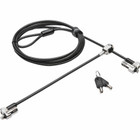








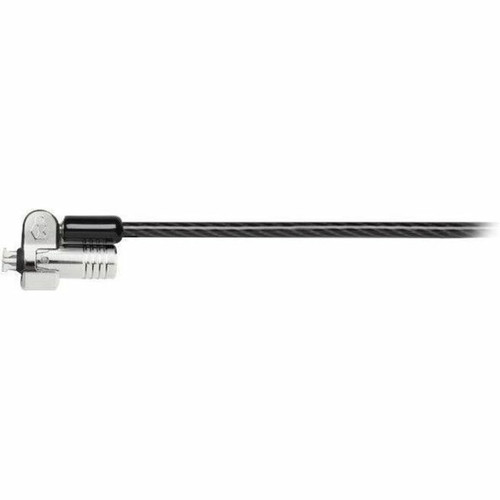
Kensington K64448TAA NanoSaver Keyed Dual Head Laptop Lock - Notebook Security Cable - TAA Compliant

Business volume discounts
Technical guidance
Preparation & staging
QC · ON · AB · BC
Product Features
Product Overview
The Kensington K64448TAA NanoSaver Keyed Dual Head Laptop Lock delivers reliable physical security for notebooks in business, government, and institutional environments. This cable lock features a dual-head design that anchors securely to standard Kensington Security Slot (K-Slot) ports found on most laptops, tablets, and other portable devices.
Built with a compact and durable construction, the lock minimizes desk clutter while providing a visible theft deterrent. Its keyed mechanism offers straightforward operation without the complexity of combination locks, making it suitable for shared or managed device deployments where key control is preferred.
This section brings together practical product details such as Lock Configuration Type, Device Supported, TAA Compliant, so buyers can judge configuration, deployment fit, and day-to-day suitability with less guesswork.
Technical Overview
This lock utilizes a keyed cylinder that requires a physical key for locking and unlocking, providing a simple and direct security method. The dual-head design ensures compatibility with a wide range of notebook models equipped with K-Slots, offering flexibility across different device brands and sizes.
The cable is engineered for strength and resistance to cutting or tampering, while the compact form factor keeps the lock unobtrusive during daily use. TAA compliance confirms that the product meets U.S. government procurement standards under the Trade Agreements Act, which is essential for federal contracts and many enterprise purchasing programs.
This section brings together practical product details such as Lock Configuration Type, Device Supported, TAA Compliant, so buyers can judge configuration, deployment fit, and day-to-day suitability with less guesswork.
Key Product Advantages
The Kensington NanoSaver lock combines practical security with compliance features that meet rigorous organizational requirements.
For buyers comparing similar models, the strongest advantage is usually the balance between dependable day-to-day operation and a simpler rollout experience. That means less time spent troubleshooting fit, compatibility, or user adoption after installation, which is especially important for shared business environments and repeat purchasing decisions.
Advantages are also easier to justify when they translate into measurable operational value, such as less downtime, more consistent user experience, easier replacement planning, or better alignment with existing accessories and workflows. That practical value tends to matter more than broad marketing language when teams are standardizing purchases.
Deployment / Use Cases
This lock is ideal for securing notebooks in settings where devices are left unattended but need to remain accessible for authorized users. Common applications include office workstations, library study carrels, classroom desks, and retail kiosks where theft prevention is a priority.
The TAA compliance makes it particularly suitable for government agencies, educational institutions receiving federal funding, and corporations with strict procurement policies. It also serves well in healthcare environments, co-working spaces, and hospitality setups where device security must balance ease of use with regulatory adherence.
Government and Enterprise Security
Deploy in federal offices, state agencies, or corporate facilities where TAA-compliant hardware is mandated for procurement contracts.
- Meets U.S. Trade Agreements Act requirements.
- Simplifies compliance documentation for IT asset managers.
Educational and Institutional Use
Secure laptops in schools, universities, or libraries where devices are shared but need protection during unsupervised hours.
- Key control allows staff to manage access centrally.
- Durable construction withstands frequent locking and unlocking.
Highlights
- Keyed dual-head laptop lock for notebook security.
- Compatible with standard Kensington Security Slot (K-Slot) ports.
- TAA compliant for U.S. government and enterprise procurement.
- Compact design minimizes desk clutter and footprint.
- Durable cable construction resists cutting and tampering.
- Simple key operation without combination complexity.
- Suitable for shared or managed device environments.
- Manufacturer part number K64448TAA for easy identification.
Specifications
| Specifications | |
|---|---|
| Manufacturer | Kensington Computer Products Group |
| Manufacturer Part Number | K64448TAA |
| Brand Name | Kensington |
| Product Line | NanoSaver |
| Product Name | NanoSaver Keyed Dual Head Laptop Lock |
| Product Type | Cable Lock |
| Lock | |
| Lock Configuration Type | Keyed Lock |
| Miscellaneous | |
| Device Supported | Notebook |
| TAA Compliant | Yes |
User Manual
FAQ
What type of lock mechanism does the Kensington K64448TAA use?
The Kensington K64448TAA uses a keyed lock mechanism. It requires a physical key to lock and unlock the cable, providing a straightforward security method that is easy to manage in environments where key control is preferred over combinations, such as in offices or institutions with multiple users.
Which devices are compatible with this laptop lock?
This lock is designed for notebooks (laptops) that feature a standard Kensington Security Slot (K-Slot). The dual-head design ensures broad compatibility with most laptop brands and models equipped with these slots, making it versatile for securing a wide range of portable devices in business or educational settings.
What does TAA compliant mean for this product?
TAA compliant indicates that the Kensington K64448TAA meets the requirements of the U.S. Trade Agreements Act. This compliance is crucial for government procurement, as it ensures the product is eligible for purchase by federal agencies and many enterprises that mandate TAA adherence, simplifying the buying process for contracts and institutional orders.
How does the compact design benefit users?
The compact design of the Kensington NanoSaver lock reduces desk clutter and maintains a low profile when secured to a notebook. This makes it less obtrusive during daily use while still providing a visible theft deterrent, ideal for workspaces where aesthetics and functionality need to balance, such as in offices or public access areas.
Is this lock suitable for shared or multi-user environments?
Yes, the keyed mechanism of the Kensington K64448TAA makes it well-suited for shared or multi-user environments. Key control allows administrators or staff to manage access centrally, ensuring that only authorized personnel can unlock devices. This is particularly useful in libraries, classrooms, or co-working spaces where devices are used by different people.
What are the primary use cases for this laptop lock?
Primary use cases include securing notebooks in government offices, corporate workstations, educational institutions, libraries, healthcare facilities, and retail kiosks. Its TAA compliance and keyed operation make it ideal for environments that require regulatory adherence and straightforward security management, protecting devices from theft during unattended periods.
| Qty | Price | Available |
|---|