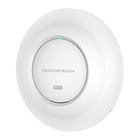








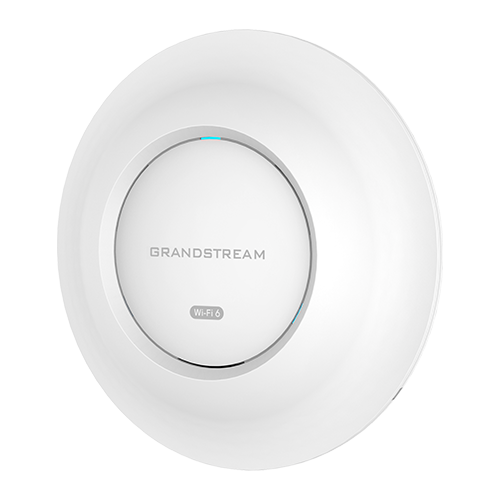
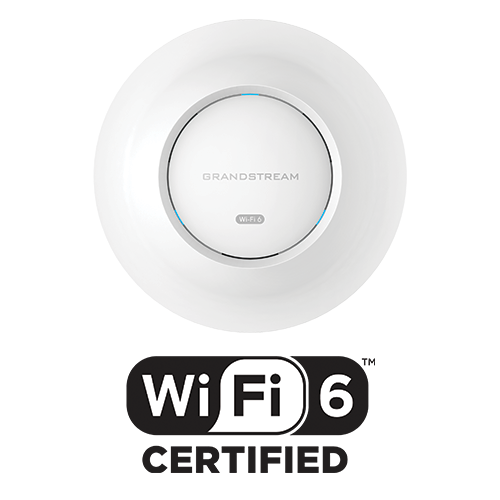


Grandstream GWN7664E AX6000 Wi-Fi 6 Access Point - Dual 2. 5G Ethernet - PoE/PoE+ - 4 x 4 MU-MIMO - 6Gbps Throughput

Business volume discounts
Technical guidance
Preparation & staging
QC · ON · AB · BC
Product Features
Technical Overview
Built on the 802.11ax Wi-Fi 6 standard, the GWN7664E utilizes dual-band 4x4:4 MU-MIMO radio architecture with DL/UL OFDMA technology to maximize spectral efficiency and reduce latency. The access point achieves 6Gbps aggregate wireless throughput and 5Gbps wired throughput across its two 2.5G Ethernet ports.
Advanced QoS mechanisms prioritize real-time applications, while security features include secure boot with digital signatures, unique security certificates, and randomized default passwords per device. The self-power adaptation automatically detects PoE or PoE+ power sources, ensuring compatibility with existing infrastructure.
Relevant factors for this section include Dual-band 4x4, SKU. When those points are considered together, they give buyers a clearer picture of how the product is equipped, how it fits into deployment, and what kind of day-to-day role it is meant to support.
A strong technical summary explains how the product's interfaces, hardware profile, and operating characteristics work together in real deployment. Buyers often need this context to confirm compatibility with existing devices, expected performance in daily use, and whether installation will be straightforward for IT staff or end users.
Key Product Advantages
The GWN7664E combines enterprise-grade wireless performance with simplified deployment and management capabilities. Its dual 2.5G Ethernet ports provide ample backhaul capacity for high-density environments, while PoE/PoE+ auto-detection eliminates power compatibility concerns.
Scalable Management
The embedded controller supports up to 50 local access points without additional hardware, with optional GDMS cloud management or GWN Manager on-premise software for flexible administration.
- No separate controller needed
- Cloud or on-premise options
- Centralized configuration
Enterprise Security
Secure boot with digital signatures, unique security certificates per device, and randomized default passwords provide robust protection against unauthorized access and tampering.
- Hardware-level security
- Unique device certificates
- Randomized credentials
Performance Optimization
Advanced QoS mechanisms ensure low-latency performance for real-time applications, while DL/UL OFDMA technology improves spectral efficiency in high-density deployments.
- Application-aware QoS
- Reduced latency
- Efficient spectrum use
Deployment / Use Cases
The GWN7664E is designed for medium-to-large business environments where reliable, high-performance wireless connectivity is essential. Its 175-meter coverage range and support for 512 concurrent clients make it ideal for offices, retail spaces, educational facilities, and multi-floor buildings.
The access point's dual 2.5G Ethernet ports provide sufficient backhaul capacity for bandwidth-intensive applications like video conferencing, large file transfers, and cloud-based services. PoE/PoE+ auto-detection simplifies installation in both new and existing network infrastructures.
Enterprise Office Networks
Provide reliable Wi-Fi connectivity for medium-to-large offices with multiple floors and high client density, supporting productivity applications and collaboration tools.
Commercial & Retail Spaces
Deliver consistent wireless coverage across retail environments, restaurants, and hospitality venues where guest connectivity and point-of-sale systems depend on stable network access.
Highlights
- 802.11ax Wi-Fi 6 access point with 6Gbps aggregate wireless throughput
- Dual-band 4x4:4 MU-MIMO with DL/UL OFDMA technology for efficient spectrum use
- Two 2.5G Ethernet ports with 5Gbps aggregate wired throughput
- Supports up to 512 concurrent Wi-Fi client devices
- 175-meter coverage range for extensive wireless coverage
- Auto-detection of PoE or PoE+ power sources with self-power adaptation
- Advanced QoS ensures real-time performance for low-latency applications
- Enterprise security with secure boot, digital signatures, and unique certificates
- Embedded controller manages up to 50 local GWN access points
- Optional GDMS cloud management or GWN Manager on-premise software
Specifications
| General | |
|---|---|
| Dual-band 4x4 | 4 MU-MIMO with DL/UL OFDMA technology |
| Brand | Grandstream |
| SKU | GWN7664E |
| Manufacturer Part Number | GWN7664E |
User Manual
FAQ
What Wi-Fi standard does the GWN7664E support?
The GWN7664E supports the 802.11ax Wi-Fi 6 standard, which provides improved efficiency, capacity, and performance compared to previous Wi-Fi generations. This standard includes technologies like OFDMA and 4x4 MU-MIMO that enhance performance in high-density environments.
How many Ethernet ports does this access point have?
This access point features two 2.5G Ethernet ports that provide 5Gbps aggregate wired throughput. These high-speed ports ensure sufficient backhaul capacity for bandwidth-intensive applications and support PoE/PoE+ auto-detection for simplified power delivery.
What is the wireless throughput of the GWN7664E?
The GWN7664E delivers 6Gbps aggregate wireless throughput across both frequency bands. This high-performance capability supports demanding applications and multiple concurrent users without compromising network performance or user experience.
How many access points can the embedded controller manage?
The embedded controller in the GWN7664E can manage up to 50 local Grandstream access points without requiring additional hardware. This provides scalable network management for medium-to-large deployments while reducing infrastructure costs.
What power options are supported by this access point?
The GWN7664E supports both PoE and PoE+ power delivery with auto-detection capability. The self-power adaptation feature automatically detects the available power source type, ensuring compatibility with existing network infrastructure and simplifying installation.
How many concurrent clients can this access point support?
This access point supports up to 512 concurrent Wi-Fi client devices, making it suitable for high-density environments like offices, educational facilities, and commercial spaces where multiple users and devices require simultaneous connectivity.
| Qty | Price | Available |
|---|