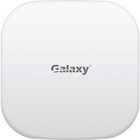







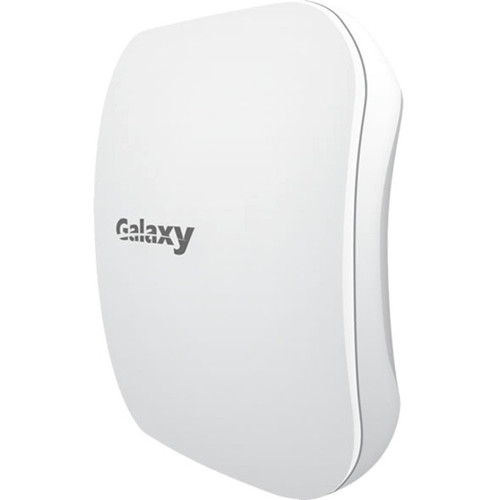

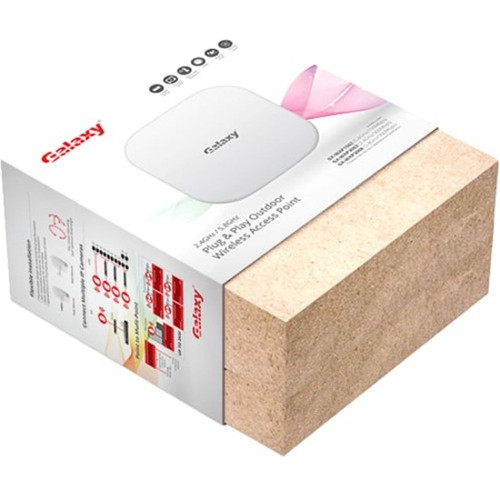
Galaxy GX-WAP3008 5 GHz Wireless Access Point - IEEE 802. 11n 300 Mbit/s - Fast Ethernet with PoE - Wall/Pole Mountable

Business volume discounts
Technical guidance
Preparation & staging
QC · ON · AB · BC
Product Features
Technical Overview
The Galaxy GX-WAP3008 utilizes the IEEE 802.11n wireless standard on the 5 GHz frequency band, providing cleaner spectrum with less interference compared to crowded 2.4 GHz bands. This band selection supports wireless transmission speeds up to 300 Mbit/s, enabling smooth data transfer for internet browsing, file sharing, and streaming applications.
Wired connectivity is handled through a single Fast Ethernet (10/100 Mbps) RJ-45 port that also functions as a PoE PD port. This allows the access point to receive both data and electrical power from a compatible PoE switch or injector, streamlining installation in locations without convenient power access. The Fast Ethernet interface ensures reliable backbone connectivity between the wireless network and existing wired infrastructure.
Relevant factors for this section include Wireless LAN Standard, Frequency Band, Wireless Transmission Speed, Ethernet Technology. When those points are considered together, they give buyers a clearer picture of how the product is equipped, how it fits into deployment, and what kind of day-to-day role it is meant to support.
Key Product Advantages
The Galaxy GX-WAP3008 offers several distinct advantages for network expansion projects. Its dedicated access point design provides focused Wi-Fi extension without the complexity of multi-function devices, while the 5 GHz operation delivers reliable performance in environments with dense wireless activity.
Simplified Installation
Power over Ethernet support eliminates the need for separate electrical wiring at the installation site, reducing deployment time and costs while enabling placement in optimal coverage locations.
- Single-cable power and data delivery
- Compatible with standard PoE switches and injectors
- Reduces electrical infrastructure requirements
Flexible Deployment
Wall and pole mounting options provide installation versatility for both indoor and outdoor environments, allowing network administrators to position the access point for optimal coverage patterns.
- Wall mountable for interior installations
- Pole-mountable for exterior deployments
- Versatile positioning for coverage optimization
Clean Spectrum Performance
5 GHz operation avoids congestion from common 2.4 GHz devices like Bluetooth peripherals and older Wi-Fi networks, resulting in more stable connections and reduced interference.
- Less crowded frequency band
- Reduced interference from neighboring networks
- Improved connection stability
Deployment / Use Cases
The Galaxy GX-WAP3008 is well-suited for extending wireless network coverage in various scenarios where existing router Wi-Fi proves insufficient. Its 5 GHz operation and PoE capabilities make it particularly effective in environments requiring reliable connectivity without complex infrastructure changes.
Common deployment scenarios include office expansions where additional coverage is needed in conference rooms or remote work areas, retail environments requiring consistent Wi-Fi for point-of-sale systems and customer access, and educational facilities needing to extend network access to classrooms or outdoor spaces. The access point also serves well in warehouse settings where metal shelving and building materials can interfere with wireless signals, as the dedicated access point can be positioned strategically to overcome these obstacles.
Office Network Extension
Extend reliable Wi-Fi to conference rooms, remote departments, or building additions without replacing existing network infrastructure, using PoE for clean installation without additional electrical work.
Outdoor Coverage Expansion
Provide wireless access in courtyards, parking lots, or outdoor seating areas using pole mounting and the 5 GHz band's ability to handle line-of-sight connections effectively.
Highlights
- IEEE 802.11n wireless standard operating on the 5 GHz frequency band
- Maximum wireless transmission speed of 300 Mbit/s for efficient data transfer
- Single Fast Ethernet (10/100 Mbps) RJ-45 port for wired network connectivity
- Power over Ethernet (PoE) PD support for simplified single-cable installation
- Wall mountable and pole-mountable form factors for flexible deployment
- Dedicated access point design focused on reliable Wi-Fi extension
- 5 GHz operation reduces interference from crowded 2.4 GHz spectrum
- Suitable for both indoor office environments and outdoor coverage areas
Specifications
| Specifications | |
|---|---|
| Manufacturer | Galaxy Canada CCTV |
| Manufacturer Part Number | GX-WAP3008 |
| Brand Name | Galaxy |
| Product Model | GX-WAP3008 |
| Product Name | 5.8GHz 300Mbps 16dBi Outdoor Wireless Access Point |
| Product Type | Wireless Access Point |
| Technical Information | |
| Wireless LAN Standard | IEEE 802.11n |
| Frequency Band | 5 GHz |
| Wireless Transmission Speed | 300 Mbit/s |
| Interfaces/Ports | |
| Ethernet Technology | Fast Ethernet |
| Number of Network (RJ-45) Ports | 1 |
| PoE PD Port | Yes |
| Physical Characteristics | |
| Form Factor | Wall Mountable,Pole-mountable |
User Manual
FAQ
What Wi-Fi standard does the Galaxy GX-WAP3008 support?
The Galaxy GX-WAP3008 wireless access point supports the IEEE 802.11n Wi-Fi standard. This standard provides reliable wireless connectivity with data transfer rates up to 300 Mbit/s when operating on the 5 GHz frequency band. IEEE 802.11n incorporates multiple-input multiple-output (MIMO) technology and channel bonding to deliver improved throughput and range compared to earlier wireless standards.
Does this access point support Power over Ethernet?
Yes, the Galaxy GX-WAP3008 features a Power over Ethernet (PoE) PD port. This means the access point can receive both data and electrical power through a single Ethernet cable when connected to a compatible PoE switch or PoE injector. This capability simplifies installation by eliminating the need for a separate power outlet at the mounting location, allowing for more flexible placement in optimal coverage areas.
What frequency band does this wireless access point use?
The Galaxy GX-WAP3008 operates exclusively on the 5 GHz frequency band. This band offers several advantages over the more common 2.4 GHz band, including less interference from other wireless devices, more available channels, and generally cleaner spectrum. The 5 GHz band is particularly effective in environments with dense wireless activity, though it has slightly shorter range through obstacles compared to 2.4 GHz signals.
How fast is the Ethernet connection on this access point?
The Galaxy GX-WAP3008 features a single Fast Ethernet port, which supports data transfer speeds of 10/100 Mbps. This provides sufficient bandwidth for the access point's maximum wireless throughput of 300 Mbit/s, as the wireless speed represents the combined theoretical maximum across all connected devices rather than per-device throughput. The Fast Ethernet connection ensures reliable backbone connectivity between the wireless network and your existing wired infrastructure.
What mounting options are available for this access point?
The Galaxy GX-WAP3008 supports both wall mounting and pole mounting configurations. The wall mountable design allows for installation on vertical surfaces in indoor environments like offices or warehouses. The pole-mountable capability enables deployment on existing infrastructure such as light poles, building exteriors, or dedicated mounting poles for outdoor coverage expansion. This flexibility allows network administrators to position the access point optimally for specific coverage patterns and environmental conditions.
What is the maximum wireless speed of this access point?
The Galaxy GX-WAP3008 delivers wireless transmission speeds up to 300 Mbit/s when operating under ideal conditions. This maximum throughput is achieved through the IEEE 802.11n standard's use of channel bonding and MIMO technology on the 5 GHz band. Actual speeds experienced by end users will vary based on factors including distance from the access point, environmental obstacles, interference from other wireless devices, and the capabilities of connected client devices.
| Qty | Price | Available |
|---|